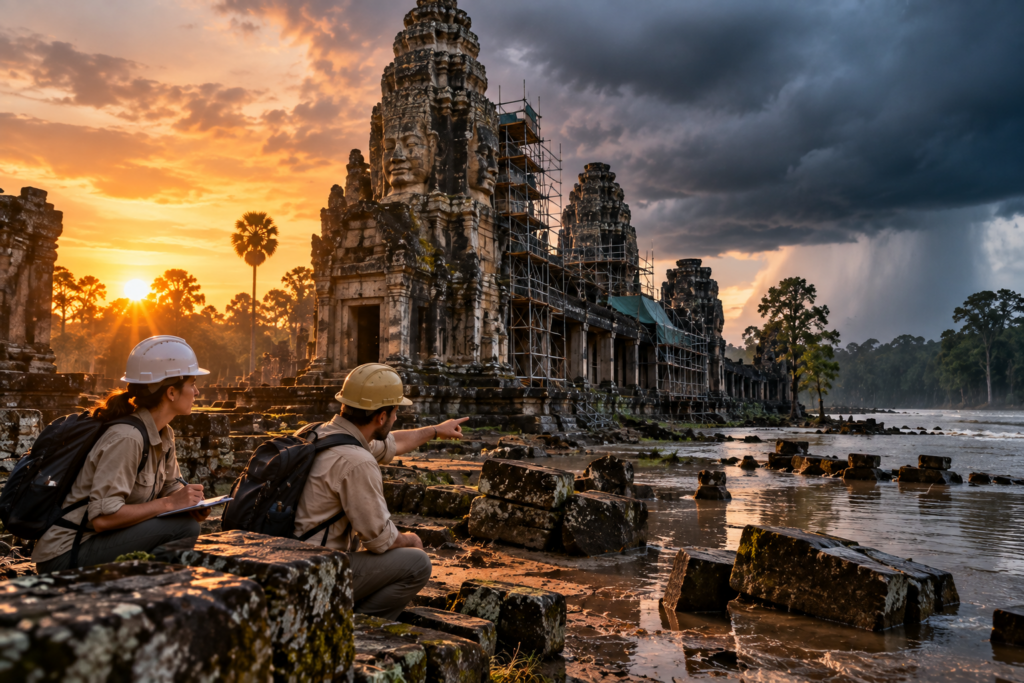
When Climate Change Threatens the Past: The New Battle to Protect Cultural Heritage
A historic building can survive for hundreds of years and still face a threat it was never designed to withstand.
Rising temperatures can weaken materials. Heavy rainfall can damage foundations. Coastal erosion can eat away at historic settlements. Drought can change the landscapes surrounding archaeological sites. Wildfires can destroy cultural places in a matter of hours.
Climate change is no longer a distant concern for the people responsible for protecting cultural heritage. It is becoming a practical conservation problem.
UNESCO now describes historic sites, living traditions and cultural practices as increasingly exposed to rising temperatures, extreme weather and environmental degradation. ICOMOS, the international organization focused on monuments and sites, calls climate change the fastest-growing global threat to heritage.
The uncomfortable reality is that protecting the past increasingly requires planning for the future.
Heritage Was Built for Its Climate — Until the Climate Changed
Many historic structures survived precisely because they were adapted to the environment in which they were built.
Ancient builders understood local materials. They knew how water moved through a landscape. They designed roofs, walls, courtyards and drainage systems around the weather they experienced.
The problem is that the conditions around these structures are changing.
A building that handled occasional extreme rainfall may struggle when intense storms become more frequent. A coastal settlement designed around a relatively stable shoreline faces a different future when sea levels rise. A historic landscape shaped by predictable seasonal patterns can be transformed by prolonged drought.
This is one reason climate adaptation for cultural heritage is not simply about repairing damage after a disaster.
Conservation specialists increasingly have to ask a different question: How will this place behave under the climate of the next several decades?
That requires combining historical knowledge with climate science, monitoring technology and local experience.
The Threat Is Bigger Than Famous Monuments
It is easy to imagine climate risk as a problem for famous landmarks.
In reality, the exposure is much broader.
Historic neighbourhoods, archaeological landscapes, religious buildings, cultural routes, traditional settlements and landscapes connected with local communities can all be affected.
ICOMOS reports that climate change has become the fastest-growing threat to World Heritage properties. Earlier assessments found climate impacts already affecting one in six cultural World Heritage properties, while the organization continues to expand tools for assessing vulnerability and adaptation.
That scale changes the economics of preservation.
There are only so many specialists, restoration teams and public funds available. If climate risks increase across thousands of sites simultaneously, conservation can no longer rely exclusively on emergency intervention.
Prevention becomes much more important.
Water May Be One of the Biggest Enemies
Water has always been both a creator and destroyer of cultural landscapes.
Rivers supported civilizations. Rain shaped agriculture. Coastal locations enabled trade.
But excessive or poorly timed water can be devastating.
Flooding can penetrate historic buildings and accelerate the deterioration of stone, brick, timber and plaster. Repeated wetting and drying can place additional stress on materials. Coastal erosion can gradually remove the land supporting historic structures.
Cartagena de Indias in Colombia provides a contemporary example. A 2026 climate risk assessment by ICOMOS and its partners identifies sea-level rise, extreme rainfall, heat waves and storm intensification among the risks affecting heritage and local cultural traditions in the area.
The response is not limited to protecting individual buildings.
Proposed adaptation measures include mangrove and coral restoration, community monitoring, restoration of vegetation and the use of local knowledge in planning.
That approach reflects an important change in conservation thinking.
Sometimes the best way to protect a historic place is to restore the ecosystem around it.
Heat Is Becoming a Heritage Problem Too
Heat receives less attention than floods or hurricanes because its damage can be gradual.
But extreme temperatures can be equally disruptive.
Historic masonry, plaster, timber and other materials respond to temperature and humidity changes. Archaeological sites can also face increased biological growth, moisture stress and changes in the surrounding environment.
The people who care for these places face another problem: historic structures were not necessarily designed for today’s climate extremes.
Air-conditioning is not always a suitable answer. Installing modern mechanical systems inside an old building can affect the structure, appearance, energy consumption and historical character of the site.
This is where adaptation becomes a balancing act.
Conservation specialists have to protect the building without turning it into something fundamentally different.
What Angkor Can Teach Us About Adaptation
One of the clearest examples of this new approach can be found at Angkor in Cambodia.
The vast archaeological landscape faces several climate-related pressures, including rising temperatures, drought, erratic rainfall and biological growth, according to a 2026 climate risk assessment published by the Preserving Legacies programme and partners.
What makes the response particularly interesting is the combination of old and new.
Researchers are examining historically resilient water-management systems while also using modern monitoring technology. Three-dimensional photogrammetry can help specialists observe changes in temple structures, while traditional construction and restoration techniques remain part of the adaptation strategy.
The lesson is simple but important.
Climate adaptation does not necessarily mean replacing traditional knowledge with modern technology.
Sometimes the most effective solution comes from putting the two together.
Ancient Knowledge Is Becoming Valuable Again
This may be one of the most unexpected consequences of the climate crisis.
The past can contain practical information about resilience.
Historic communities lived through droughts, floods, heat and changing environmental conditions. They developed ways to manage water, choose materials and organize settlements around local climates.
Some of that knowledge has survived.
ICOMOS’s climate adaptation work increasingly emphasizes the relationship between heritage, traditional knowledge and climate resilience. Its research highlights the possibility of using historic practices alongside contemporary science rather than treating them as competing systems.
At Tchogha Zanbil in Iran, for example, ancient builders developed sophisticated approaches to water management, including drainage systems, channels, protective brick façades and other techniques designed to deal with moisture. Modern conservation research is examining such historical strategies as potential sources of knowledge for contemporary adaptation.
The irony is hard to miss.
As modern societies search for new climate solutions, some of the answers may be hidden in techniques developed centuries ago.
Climate Change Can Destroy Intangible Heritage Too
A damaged building is visible.
A disappearing cultural practice is harder to measure.
Yet climate change can affect both.
When floods force communities to relocate, traditional ways of life can be disrupted. When drought changes agriculture, knowledge associated with particular crops and landscapes can become harder to maintain. When coastal communities lose access to familiar fishing grounds, traditions connected with those places can also be affected.
UNESCO increasingly treats climate and culture as interconnected. Its current climate work emphasizes that local and Indigenous knowledge can support adaptation, strengthen resilience and help communities manage land, water and ecosystems.
This expands the definition of conservation.
Protecting heritage may mean protecting not only a building, but also the relationship between a community and the environment surrounding it.
The New Goal Is Resilience, Not Just Restoration
For generations, heritage conservation often followed a familiar sequence.
Something was damaged.
Experts assessed it.
Restoration began.
The climate crisis complicates that model because the original environmental conditions may never return.
Restoring a building to its historical appearance does not necessarily make it resilient to future climate conditions.
That is why the vocabulary of conservation is changing.
Terms such as adaptation, vulnerability, resilience and risk assessment are becoming increasingly common in heritage management.
In 2026, ICOMOS and its partners launched the Heritage Adapts campaign with a goal of supporting at least 3,000 heritage sites and practices in locally led climate adaptation by 2030. The campaign reflects a broader shift toward proactive preparation rather than waiting for damage to occur.
The implication is significant.
Heritage managers increasingly need to think like risk managers.
They have to identify vulnerabilities before they become emergencies.
The Financial Problem Behind Cultural Preservation
There is another issue that receives less attention: money.
Climate adaptation costs money, and cultural heritage often competes with housing, healthcare, infrastructure and disaster response for limited public resources.
A small historic community may know exactly what is happening to its environment and still lack the resources to respond.
That is why international programmes are increasingly focused on building local capacity rather than simply funding individual restoration projects.
The Preserving Legacies programme, for example, works with heritage custodians to assess climate vulnerability, visualize local risks and develop adaptation strategies. Its recent projects span sites facing very different threats, from drought in Cambodia to extreme heat and sea-level rise in West Africa and Colombia.
The approach recognizes something conservation specialists have learned repeatedly:
Local communities often understand the problem before international institutions arrive.
The challenge is giving them the scientific tools, funding and political support to act.
Should Every Heritage Site Be Saved Exactly as It Is?
This may become one of the hardest questions of the coming decades.
What happens when climate conditions make permanent preservation impossible?
Should a coastal structure be moved?
Should part of a historic settlement be documented digitally rather than physically preserved?
Should conservation priorities change as risks become more severe?
There are no universal answers.
Moving a building can protect its physical structure while destroying its relationship with the surrounding landscape. Digital documentation can preserve information without preserving the place itself. Adaptation measures can protect a site while altering its historic appearance.
Every decision involves trade-offs.
That is why climate adaptation in cultural heritage cannot be reduced to engineering.
It is also a question of identity, memory and community values.
Heritage Can Be Part of the Climate Solution
The relationship between climate and heritage is not entirely negative.
Historic buildings can sometimes offer lessons in low-energy design. Traditional settlements often developed passive approaches to shade, ventilation and water management. Indigenous and local knowledge can contribute to ecosystem management and climate resilience.
UNESCO now explicitly frames culture and heritage as potential resources for climate action rather than merely casualties of environmental change.
That changes the role of conservation.
A historic building does not have to be treated only as something fragile that society must protect.
It can also be a source of ideas.
Traditional architecture, agricultural knowledge, landscape management and community practices can inform contemporary approaches to adaptation.
The past becomes useful in a very practical sense.
The Next Era of Heritage Conservation Has Already Begun
The old image of heritage preservation is increasingly incomplete.
It is no longer enough to restore a monument, reopen the doors and declare the job finished.
The surrounding environment is changing. Extreme weather is becoming a planning issue. Communities are facing new risks. Technologies are improving the way sites are monitored. Traditional knowledge is gaining renewed attention.
The most successful conservation projects of the future will probably combine all of these elements.
They will use climate science without ignoring historical knowledge. They will use digital tools without replacing physical conservation. They will involve engineers and historians alongside the communities who give heritage its meaning.
And they will accept a difficult truth: protecting the past does not always mean keeping everything exactly as it was.
Sometimes preservation means adaptation.
Sometimes it means changing how a place is managed.
Sometimes it means learning from the people who lived there before modern climate models existed.
The cultural heritage of the future will ultimately depend on whether societies can make that shift in time.
The question is no longer simply how to save yesterday’s buildings from today’s weather.
It is whether we can protect the knowledge, places and identities that connect people to the past while preparing them for a climate that the past never had to face.