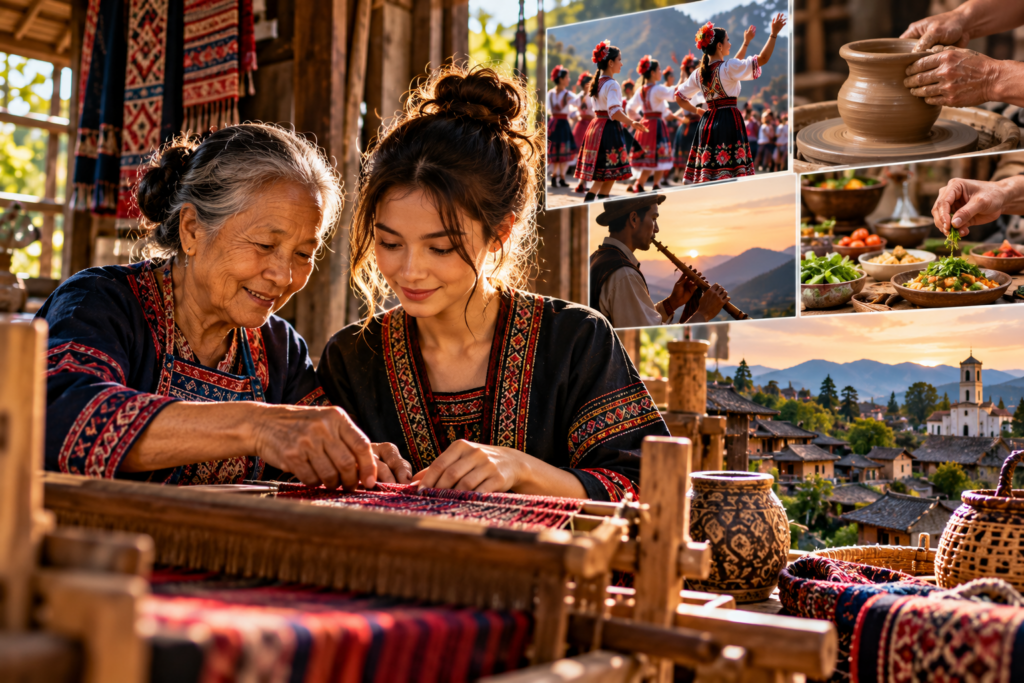
Living Heritage in a Changing World: Why Traditional Culture Still Matters
What happens when a tradition stops being part of everyday life?
There is rarely a dramatic answer. A craft workshop closes. A local song is performed less often. Children stop learning an old technique. A ritual becomes something people watch rather than participate in. Within a generation or two, knowledge that once seemed ordinary can become difficult to recover.
That is the challenge behind living cultural heritage.
Unlike a historic building or an archaeological object, intangible cultural heritage cannot simply be restored and placed somewhere safe. It depends on people who know the practice, understand its meaning and are willing to pass it on.
That makes cultural preservation a very different task in the modern world.
UNESCO defines intangible cultural heritage through practices, knowledge, skills and expressions that communities recognize as part of their heritage. These include oral traditions, performing arts, social practices, rituals, knowledge connected with nature and traditional craftsmanship. Crucially, such heritage is continuously recreated as it moves between generations.
In other words, living heritage survives by being used.
And that may be its greatest strength — and its greatest vulnerability.
Cultural Heritage Is More Than Monuments
For a long time, the word “heritage” naturally suggested something physical.
A historic palace. An ancient settlement. A religious building. A museum collection. A manuscript protected behind glass.
Those things remain essential, but they represent only one side of cultural heritage.
The other side is harder to photograph.
It is the knowledge held by a craftsperson. The melody remembered by a musician. The stories passed through families. The techniques taught through apprenticeship. The rituals that bring communities together. The knowledge of plants, landscapes, weather or materials accumulated over generations.
UNESCO describes this as living heritage because it exists in the present rather than simply belonging to the past. It can be traditional and contemporary at the same time. It can also change as communities respond to new social, economic and environmental conditions.
That distinction is increasingly important.
A tradition does not have to look exactly as it did centuries ago to remain culturally meaningful.
In fact, refusing to let it change can sometimes be a faster way to make it disappear.
The Quiet Crisis of Cultural Transmission
The biggest threat to many traditional practices is not destruction.
It is interruption.
Cultural knowledge has historically moved through ordinary human contact. Children watched adults. Apprentices worked beside experienced craftspeople. Younger musicians learned directly from older performers. Families repeated rituals because that was simply how life worked.
Modern life has disrupted many of those patterns.
People move more frequently. Cities grow. Working hours change. Families live farther apart. Traditional occupations compete with mass production. Younger generations have access to an enormous global culture that exists alongside — and sometimes competes with — local traditions.
UNESCO identifies transmission between generations as central to safeguarding intangible cultural heritage. The organization notes that the viability of a practice depends on the continued transfer of the knowledge and skills required to perform or embody it.
This creates a deceptively simple problem.
You can document a tradition without transmitting it.
And documentation alone does not guarantee survival.
A Video Cannot Become an Apprentice
Digital technology has transformed cultural preservation.
A disappearing language can be recorded. A traditional performance can be filmed. A specialist technique can be photographed from multiple angles. Archives can store material that once existed only in the memories of individuals.
This is enormously valuable.
But there is a difference between recording knowledge and learning knowledge.
A video can demonstrate how an experienced craftsperson works. It cannot automatically provide the years of practice required to understand pressure, timing, material behaviour or subtle variations.
The same applies to music, oral traditions and ceremonial practices.
Living heritage is not simply information.
It is knowledge combined with experience, context and meaning.
That is why UNESCO places such strong emphasis on transmission and education rather than documentation alone. Formal education can help, but informal learning within communities remains equally important.
The person standing beside the expert may still be the most important technology in the room.
Why “Preserving” Culture Can Be the Wrong Idea
There is an obvious temptation when discussing endangered traditions: preserve everything exactly as it is.
It sounds reasonable.
It is also problematic.
Living traditions naturally evolve. A musical form can absorb new influences. A craft can adapt to new materials. A festival can change as its community changes. A traditional practice can move from a rural environment into an urban one.
UNESCO explicitly describes safeguarding as an effort to maintain viability rather than freeze intangible heritage in some supposedly original form. The goal is to transfer knowledge, skills and meaning while allowing traditions to continue evolving.
That changes the role of cultural preservation.
The question is no longer:
How do we keep this exactly the way it was?
It becomes:
How do we make sure people can continue to practice it meaningfully?
That is a much more useful question.
Young People Are Becoming Cultural Producers
There is a persistent stereotype that modern young people are abandoning traditional culture.
The reality is more complicated.
Younger generations are often changing the way cultural heritage is presented, learned and shared.
A traditional musical style can find a new audience through streaming platforms. A craft technique can become part of contemporary design. An old story can be reinterpreted through animation, games or digital publishing. A language can be taught through online communities rather than only through family conversation.
None of this automatically guarantees preservation.
But it creates new pathways for transmission.
UNESCO’s approach to living heritage increasingly emphasizes the importance of education and meaningful participation by communities. Its framework treats transmission as a dynamic process in which heritage is recreated rather than mechanically copied.
That means young people should not simply be viewed as an audience for heritage.
They can also be its next creators.
The Internet Has Changed Who Can Discover a Tradition
The digital world has created an unusual opportunity for cultural heritage.
Geography is no longer the same barrier it once was.
Someone living thousands of kilometres from a community can encounter its music, language, craft techniques or oral history within seconds. Members of a diaspora can reconnect with traditions that might otherwise become distant. Researchers can collaborate across borders. Communities can create their own digital archives instead of depending entirely on outside institutions.
This can give vulnerable traditions visibility.
But visibility and understanding are not the same thing.
A short viral video may attract millions of views while removing a practice from its cultural context. A traditional design can become a fashionable visual style without any understanding of the knowledge behind it.
The more accessible heritage becomes, the more important context becomes.
Digital preservation works best when it supports living communities rather than turning their culture into content.
AI Is Opening a New Cultural Debate
The arrival of generative AI adds another layer to the discussion.
UNESCO’s 2026 work on living heritage and education highlights both the opportunities and challenges created by artificial intelligence. AI could support documentation, digital archiving, local-language initiatives and creative expression. At the same time, UNESCO stresses the need to consider who creates, curates and distributes cultural material — and how that material is interpreted or commercialized.
That raises difficult questions.
If an AI system can reproduce the visual characteristics of a traditional craft, has the craft been preserved?
If an algorithm can imitate a musical style, who owns the result?
If an endangered language is used to train a model, who controls the resulting technology?
These are not purely technical questions.
They involve cultural ownership, consent, identity and economic value.
The more powerful digital tools become, the more important it is to distinguish between access to culture and ownership of culture.
Traditional Knowledge Can Have Modern Value
Cultural heritage is sometimes treated as something valuable primarily because it belongs to the past.
That is too narrow.
Traditional knowledge can have contemporary social, educational and economic value.
Craftsmanship can support creative industries. Cultural practices can strengthen community connections. Traditional ecological knowledge can contribute to environmental resilience. Cultural tourism can create income when it is developed responsibly and with meaningful community participation.
UNESCO’s guidance on intangible cultural heritage explicitly recognizes economic dimensions while stressing the need for heritage-sensitive and rights-based approaches. The objective is to increase positive economic effects without damaging the viability of the cultural practice itself.
That distinction matters.
Commercial success can help a tradition survive if it gives practitioners a sustainable livelihood.
It can also damage a tradition if outside demand determines what the community is expected to produce.
The difference comes down to control.
Who decides what is shared?
Who benefits?
Who defines what remains meaningful?
The Community Has to Stay at the Centre
This is perhaps the most important principle in modern heritage policy.
A cultural practice cannot simply be declared valuable by an institution and then preserved on behalf of the people who practice it.
UNESCO’s convention emphasizes the participation of the communities, groups and individuals who create, maintain and transmit intangible heritage. Community recognition is fundamental to the concept itself.
That means cultural institutions have an important supporting role, but they cannot replace the people who carry the knowledge.
Museums can document.
Archives can preserve.
Schools can teach.
Governments can fund.
Technology can amplify.
But communities ultimately give living heritage its meaning.
Without that connection, preservation can become an exercise in collecting cultural fragments rather than sustaining culture itself.
Urban Life Is Not the End of Tradition
Another common assumption is that traditional culture belongs primarily to rural communities.
Modern heritage research tells a more complicated story.
Living heritage exists in cities too.
Urban communities create festivals, maintain food traditions, practice crafts, preserve languages, perform music and develop new forms of cultural expression. Migration can also create new communities in which traditions are combined, adapted and reinterpreted.
UNESCO’s recent guidance on intangible cultural heritage in urban contexts specifically examines how safeguarding can be integrated into urban development and planning through community-centred approaches.
This matters because the future of cultural heritage will increasingly be urban.
If preservation strategies assume that traditions must remain in their original physical environments, they risk overlooking how culture actually behaves in a mobile world.
Traditions travel.
People carry them.
Cities transform them.
New generations reinterpret them.
What Successful Preservation Really Looks Like
There is no universal formula for keeping living heritage alive.
One community may need an apprenticeship programme. Another may need support for language education. Somewhere else, the priority may be access to materials, cultural spaces or opportunities for younger practitioners.
UNESCO’s approach reflects that diversity. Safeguarding can involve identification, documentation, research, promotion, education, revitalization and the strengthening of the conditions that allow traditions to continue.
The common denominator is not a particular technology or institution.
It is continuity.
Someone must still want to learn.
Someone must still be willing to teach.
And the practice must still have meaning in contemporary life.
The Future of Heritage Will Not Be a Replica of the Past
Cultural preservation is entering a new phase.
The objective is no longer simply to protect old things from disappearing. It is to create conditions in which knowledge, skills and cultural practices can continue to evolve.
That requires a different mindset.
Heritage managers need to understand digital culture. Educators need to create opportunities for intergenerational learning. Technology companies need to think seriously about cultural data and consent. Communities need a stronger voice in decisions affecting their traditions.
And audiences need to understand that cultural heritage is not just something to consume.
It is something people live.
The most successful traditions will probably be the ones capable of crossing that difficult line between continuity and change. They will retain enough meaning to remain recognizable while adapting enough to remain useful.
That is why living heritage matters in the first place.
The past does not survive because someone puts it in a box.
It survives because someone, somewhere, still finds a reason to carry it forward.