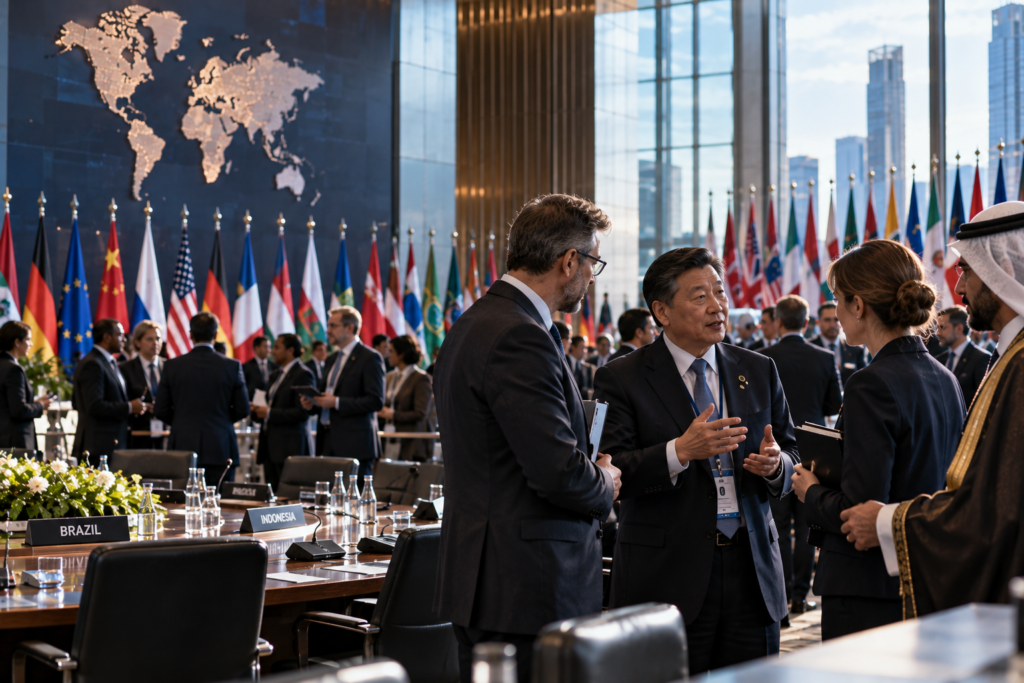
The Middle-Power Moment: Why Smaller States Matter More in a Changing World
For much of modern history, international politics has often been explained through the actions of the world’s most powerful countries. Major economies, military powers and permanent members of key international institutions naturally attracted the greatest attention.
But the structure of world affairs is becoming less straightforward.
As global influence becomes more distributed, countries outside the traditional group of dominant powers are gaining new opportunities to shape international decisions. Some have valuable resources, strategic geography or growing markets. Others have diplomatic networks that allow them to maintain relationships with competing powers at the same time.
These countries are often described as middle powers. Their influence does not come from overwhelming military or economic strength. It comes from their ability to connect interests, build coalitions and offer something that larger powers need.
A Different Kind of Global Influence
A middle power does not have to dominate an international system to influence it.
Its importance may come from its location, economic position, access to resources, technological capabilities or diplomatic credibility. A country that can maintain productive relationships with several competing blocs may become particularly valuable when larger powers struggle to communicate with one another.
This is becoming more relevant as the international system becomes more fragmented. The World Economic Forum’s 2026 Global Cooperation Barometer found that traditional forms of multilateral cooperation have weakened in several areas, while more flexible and smaller arrangements have continued to develop.
The shift matters because international cooperation does not necessarily disappear when large institutions struggle. It can move into smaller and more practical partnerships.
Diplomacy Is Becoming More Flexible
The old idea of diplomatic alignment suggested relatively stable relationships. Countries formed alliances, maintained long-term partnerships and generally approached international questions through those established structures.
Today’s environment is more fluid.
A government can cooperate closely with one group of countries on trade while working with another on energy, security or technology. It may compete with a neighbour in one area and negotiate with it in another.
This flexibility can create uncertainty, but it can also give middle powers room to manoeuvre.
Instead of choosing one permanent geopolitical camp, some governments are trying to maintain several relationships simultaneously. Their objective is not necessarily neutrality. It is strategic flexibility.
The Value of Being a Connector
One of the most useful roles for a middle power is connecting countries that do not naturally cooperate.
This can involve formal diplomacy, economic agreements, security discussions or quieter negotiations that never attract much public attention. A country does not need to solve an international dispute on its own to become important. Sometimes simply providing a channel for communication can have strategic value.
Carnegie Endowment’s 2026 analysis describes this as a potential “middle power moment”, arguing that second-tier but systemically important states could play a larger role in rebuilding international cooperation.
Their advantage is partly structural. They are often large enough to matter but flexible enough to work across different diplomatic relationships.
Economic Connections Create Political Leverage
Economic importance can also translate into diplomatic influence.
Countries that control important trade routes, resources, manufacturing capacity or growing consumer markets can become difficult for larger powers to ignore. Their value increases further when global supply chains are being reconsidered.
The World Trade Organization’s 2026 World Trade Report describes a global economy in which economic power is becoming more widely distributed and trade relationships are being reshaped by geopolitical considerations.
This creates a complicated environment for middle powers. They can benefit from new opportunities, but they also face pressure from larger economies seeking stronger alignment.
The challenge is to use economic relationships without becoming excessively dependent on any single partner.
The Rise of Regional Diplomacy
As global institutions face greater pressure, regional cooperation is becoming increasingly important.
Neighbouring countries often share immediate interests that are easier to address at a regional level than through global negotiations. Infrastructure, transportation, energy, migration, water resources and security can all create incentives for practical cooperation.
Regional diplomacy can therefore become a testing ground for broader international arrangements.
A successful regional agreement can demonstrate that countries with different political systems and strategic interests are still capable of reaching practical compromises. At the same time, regional tensions can spread quickly when several neighbouring countries are connected through competing alliances.
This makes regional powers increasingly important to the wider international system.
Global Institutions Still Matter
The growing influence of middle powers does not mean that major international institutions have become irrelevant.
The opposite may be true.
The World Trade Organization’s 2026 report argues that rules-based cooperation remains important precisely because a more fragmented global economy creates greater risks for smaller economies. Its modelling suggests that severe geopolitical fragmentation of the trading system could produce substantial losses in global GDP and trade.
The problem is that existing institutions were built for a different distribution of global power.
Economic influence has changed. New technologies have emerged. Trade now involves digital services, data, complex supply chains and security concerns that were far less important when many existing rules were designed.
The institutions themselves therefore face a difficult task: adapt without losing the principles that made international cooperation valuable in the first place.
Cooperation Is Not Disappearing
The current geopolitical environment can sometimes create the impression that international cooperation is collapsing altogether.
The evidence is more complicated.
The 2026 Global Cooperation Barometer found that overall global cooperation remained broadly stable, even though its composition was changing. Cooperation in some traditional areas weakened, while collaboration through smaller and more flexible arrangements continued to grow.
This distinction is important.
The world may not be moving from cooperation to complete isolation. Instead, cooperation may be changing its shape.
Large universal agreements can be difficult to negotiate when strategic interests diverge. Smaller coalitions can sometimes move faster because their members have a clearer shared objective.
That does not make them a complete replacement for global institutions. It creates another layer of international cooperation.
The New Importance of Strategic Balance
For middle powers, the changing environment creates a delicate balancing act.
They need access to international markets, investment, technology and security partnerships. At the same time, excessive dependence on one major power can reduce their diplomatic freedom.
This makes diversification increasingly important.
A country with multiple economic and diplomatic relationships can have greater room to respond when geopolitical conditions change. It can negotiate rather than simply accept the terms offered by a stronger partner.
But balancing is not easy. Larger powers may increasingly expect governments to take clearer positions on strategic issues, particularly when economic policy and national security become closely connected.
The space for ambiguity can therefore become narrower even as the incentives for flexibility grow.
Technology Is Changing the Balance Again
Technology is adding another dimension to this shift.
Advanced computing, artificial intelligence, telecommunications, semiconductor manufacturing and digital infrastructure are becoming strategic assets. Countries that develop expertise in these areas can gain influence beyond what their traditional economic or military rankings might suggest.
At the same time, technological dependence can create new vulnerabilities. Governments increasingly care about where critical technologies are developed, who controls essential infrastructure and how data moves across borders.
This means that a country’s technological capabilities can become part of its diplomatic leverage.
For middle powers, investing in research, digital infrastructure and technical expertise may therefore be as important to long-term international influence as traditional diplomatic resources.
The Future May Belong to Coalitions
The emerging international system is unlikely to be defined entirely by a few permanent blocs.
Instead, it may contain overlapping coalitions formed around specific interests. One group of countries may cooperate on climate technology, another on maritime security and another on digital trade. Some countries may participate in all three without belonging completely to any single geopolitical camp.
This model is more complicated, but it can also be more adaptable.
The challenge is ensuring that flexible cooperation does not become so fragmented that there are no common rules left to hold the system together. A world made entirely of temporary deals could become unpredictable, particularly for countries without the economic or political strength to negotiate favourable terms.
Middle powers therefore have an interest in both flexibility and stability.
A Larger Role in a More Complicated World
The growing importance of middle powers does not mean that the largest countries are losing their influence. Their economic, military and technological capabilities remain central to world affairs.
What is changing is the amount of influence available beyond that small group.
As power becomes more distributed, international politics depends increasingly on countries that can connect markets, regions and diplomatic interests. Their importance may be most visible when major powers disagree and practical cooperation becomes difficult.
The new global order will therefore not be shaped only by the countries with the largest economies or strongest militaries. It will also be shaped by governments capable of building bridges between competing interests.
That may be one of the defining features of the emerging international system. Power is still important, but the ability to connect different parts of the world is becoming a form of power in its own right.