From Museum Walls to Digital Worlds: How Technology Is Changing Cultural Heritage
For most of modern history, seeing cultural heritage meant going somewhere.
You entered a museum. You stood in front of an object. You walked through a historic building. You looked at an archaeological site with your own eyes.
That model is changing.
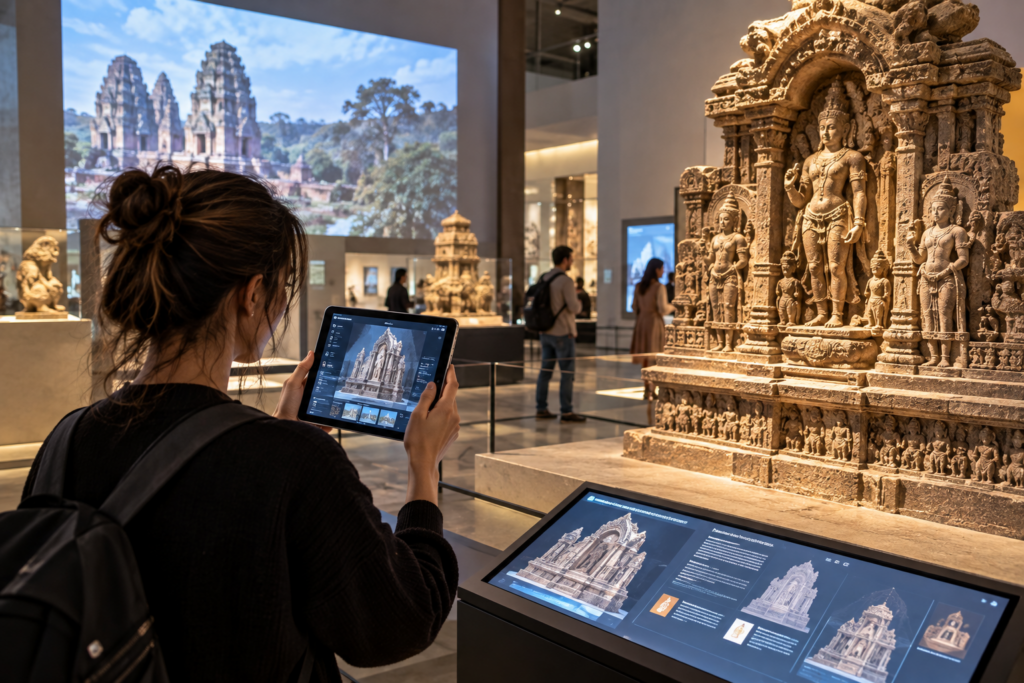
A growing part of the world’s cultural heritage is now being photographed, scanned, digitized, reconstructed and made available through screens. Museums are building digital collections. Heritage organizations are creating three-dimensional models. Virtual exhibitions can reach audiences far beyond their physical locations. Artificial intelligence is beginning to help institutions catalogue, interpret and communicate their collections.
The museum is no longer defined entirely by its walls.
That does not mean physical collections are becoming irrelevant. Quite the opposite. Digital technology is creating a second layer around them — one that can make collections easier to discover, study and experience.
UNESCO’s current work on culture and technology reflects this shift, while the International Council of Museums is examining how AI is changing everything from collection management to visitor engagement. A 2026 UNESCO–ICOM survey found that 57% of responding museums were already using AI, although more than half had no internal AI policy or strategy in place.
The digital transformation of cultural heritage is therefore moving quickly.
The bigger question is where it is going.
The Digital Museum Is No Longer a Concept
The idea of a virtual museum once sounded futuristic.
Today, it is becoming part of the normal cultural landscape.
A visitor can explore a digital collection without booking a ticket or travelling across a continent. A researcher can examine high-resolution images of objects held in distant institutions. Students can access archival material that might otherwise be unavailable to them.
UNESCO’s Dive into Heritage platform is one example of this direction. Launched in 2025, the initiative uses three-dimensional models, photographs, video, maps and digital storytelling to create immersive ways of exploring World Heritage.
The significance is bigger than convenience.
Digital access changes who gets to encounter cultural heritage.
Geography becomes less restrictive. Physical accessibility barriers can be reduced. Collections can remain available outside opening hours. Educational material can be connected directly to objects and places.
A museum visit becomes only one possible entry point.
Three-Dimensional Technology Is Changing Preservation
Digital photography has been part of museum work for years.
Three-dimensional documentation takes the idea considerably further.
A detailed 3D model can capture the shape, structure and surface characteristics of an object or architectural site. Researchers can use those models to study changes over time. Conservators can compare digital records before and after restoration. Educators can use them to explain structures that are difficult to understand from photographs alone.
There is also an important preservation advantage.
A digital record does not replace the original object, but it can provide an additional reference if the physical object is damaged, deteriorates or becomes inaccessible.
This matters particularly for cultural heritage exposed to conflict, environmental risks and other emergencies.
Digital documentation can create a record of what existed at a particular moment.
That record may later become valuable for research, restoration and public education.
Accessibility Is Becoming a Major Part of Digital Heritage
One of the strongest arguments for digital museums has little to do with technology itself.
It is access.
Not everyone can travel to major cultural institutions. Physical museums can be difficult to reach for people with mobility limitations. Language can create another barrier. Some collections are stored away from public galleries and are rarely seen.
Digital platforms can address some of these limitations.
A collection can be presented through multiple languages. Audio descriptions can support visitors with visual impairments. Captions can make audiovisual material more accessible. Interfaces can provide additional historical context without overcrowding a physical exhibition.
ICOM’s current digital strategy emphasizes accessibility, multilingual resources, digital equity and responsible use of immersive technologies as important elements of the museum sector’s digital future.
But technology does not automatically make culture accessible.
Poor interface design, limited connectivity, inaccessible websites or expensive hardware can simply create new barriers.
Digital inclusion therefore has to be treated as part of cultural policy, not as a technical afterthought.
Artificial Intelligence Is Moving Into the Museum
AI is perhaps the most significant new development in this transformation.
Museums are experimenting with artificial intelligence for collection management, administrative work, communication, research, documentation, exhibition development and visitor engagement.
The 2026 UNESCO–ICOM global survey provides a useful snapshot of where the sector stands. Among participating museums, AI use was particularly common in administration and communication, while research, documentation, exhibition development and visitor engagement were also emerging areas. Yet only 17% reported providing AI training to staff.
That gap is revealing.
Museums are adopting the technology faster than many institutions are developing the skills and governance needed to manage it.
This is not simply a software problem.
Museum professionals work with objects that have historical, cultural, legal and social significance. An inaccurate automated description can misrepresent an object. A biased system can reproduce existing gaps in collections. An AI-generated interpretation can blur the distinction between historical evidence and synthetic content.
The technology may be fast.
Cultural interpretation cannot afford to be careless.
AI Can Make Collections Easier to Search
One of the less glamorous applications of AI may become one of the most useful.
Museum collections often contain enormous amounts of information.
Thousands or millions of objects may have records containing descriptions, dates, materials, provenance information, photographs and specialist terminology. Much of that information can be difficult for the general public to search.
AI can help connect those fragments.
Machine-learning systems can assist with categorization, transcription, metadata enrichment and image analysis. Natural-language interfaces can potentially allow visitors to ask questions in ordinary language rather than searching through technical catalogues.
This could make collections significantly more discoverable.
Instead of knowing the exact name of an object, a visitor might describe what they are interested in and receive relevant results.
That changes the relationship between the public and the collection.
The catalogue becomes less like a database and more like an interface for exploration.
But Who Gets to Interpret the Past?
This is where the digital museum becomes more complicated.
Technology can help people discover cultural objects.
It can also influence how those objects are understood.
An AI system trained on incomplete or biased data may produce an incomplete interpretation. Historical terminology can carry assumptions that are no longer accepted. Objects with contested provenance may require multiple perspectives rather than one automated explanation.
ICOM has highlighted precisely these concerns as AI becomes more embedded in museums, including representation bias, intellectual property, historical accuracy, accessibility and the future role of museum professionals.
The issue is not whether AI should be allowed into museums.
It already is.
The issue is where human expertise remains essential.
A curator does more than retrieve information. A conservator does more than classify an object. A historian does more than generate a description.
They interpret evidence.
They understand uncertainty.
And sometimes, they know when there is no simple answer.
Virtual Reality Can Change the Experience of Place
Digital heritage does not have to mean looking at a flat screen.
Virtual and augmented reality can create another kind of experience.
A visitor can move through a reconstructed historical environment, examine an architectural feature from different angles or explore a site that is physically inaccessible.
For education, this can be particularly powerful.
A student does not simply read about a structure. They can experience its scale and spatial relationships.
For museums, immersive technology can also provide ways to present objects that cannot normally be handled or approached closely.
But immersion should not become entertainment for its own sake.
A spectacular digital reconstruction can create a compelling experience while quietly introducing historical assumptions that visitors may mistake for fact.
The more convincing a reconstruction becomes, the more clearly institutions need to explain what is documented, what is reconstructed and what is hypothetical.
Digital Restoration Has a New Responsibility
Restoration has always involved interpretation.
A conservator deciding how to treat a damaged object has to make choices about materials, techniques and historical evidence.
Digital restoration adds another layer.
Software can reconstruct missing visual elements, improve damaged images, restore audio or create representations of objects that no longer exist in complete form.
This can be enormously useful.
It can also create false certainty.
If a missing section of an historical object is digitally reconstructed, viewers may assume the reconstruction represents exactly what was originally there.
That is why transparency matters.
Digital heritage should clearly distinguish between the original record, documented reconstruction and speculative interpretation.
A convincing image is not necessarily an accurate image.
Cultural Heritage Is Becoming Searchable
There is a broader change happening beneath all of this technology.
Cultural heritage is becoming increasingly searchable.
Digitization allows collections from different institutions to be connected through shared metadata and online platforms. Researchers can compare materials without physically moving objects. The public can discover collections that previously existed almost entirely inside institutional catalogues.
ICOM’s 2026 discussions on AI in museums specifically identify collection metadata, automated cataloguing and the creation of large-scale publicly accessible collection data as important areas of development.
This could eventually change the economics of cultural research.
Access becomes faster.
Collaboration becomes easier.
And previously isolated collections can become part of much larger knowledge networks.
But digitization also creates a basic technical problem: digital information has to remain usable.
A file stored today may depend on software, hardware or formats that disappear tomorrow.
The Digital Archive Has Its Own Preservation Problem
It is tempting to assume that once something has been digitized, it is safe forever.
It is not.
UNESCO warned more than two decades ago that digital heritage itself faces risks from technological obsolescence, uncertain maintenance responsibilities, limited resources and inadequate preservation strategies.
The problem has only become more complicated as the volume of digital information has expanded.
Museums now need to preserve not only physical objects but also photographs, databases, websites, audiovisual material, 3D models, software-dependent experiences and other forms of born-digital heritage.
A digital collection requires long-term management.
Files need to remain readable.
Metadata needs to remain connected.
Storage needs to be maintained.
Access systems need to evolve.
Digital preservation is therefore not a one-time project.
It is an ongoing institutional responsibility.
Smaller Institutions Face a Different Reality
The digital transformation of cultural heritage can sound expensive because it often is.
Large institutions may have dedicated technology teams, digitization laboratories and specialist staff.
Smaller museums may have limited budgets, outdated equipment and very few employees.
That creates a risk of a new cultural divide.
The institutions with the strongest resources can create sophisticated digital experiences while others struggle simply to digitize their basic collections.
UNESCO’s wider analysis of digital technologies in the cultural sector identifies uneven infrastructure, limited funding, insufficient digital literacy and persistent digital divides as significant challenges to equitable participation.
This is why digital transformation cannot simply be measured by how advanced the technology looks.
A simple, searchable collection that works reliably may provide more public value than an expensive immersive installation that few people can access.
Good digital heritage is not necessarily the most spectacular.
It is the most useful.
The Human Curator Is Not Disappearing
The more technology enters museums, the more important human expertise may become.
That sounds contradictory.
It is not.
When information becomes abundant, interpretation becomes more valuable.
AI can process enormous datasets. It can identify patterns, generate descriptions and organize information at a speed no individual can match.
But cultural institutions are responsible for more than speed.
They are responsible for context, evidence, provenance and public trust.
The current UNESCO–ICOM findings underline this tension. AI adoption is advancing, but governance and staff training are lagging behind. More than half of surveyed museums reported having no internal AI policy or strategy.
The next stage of digital transformation will therefore not simply be about buying better technology.
It will be about building better institutional practices around it.
What the Digital Museum Will Look Like Next
The museum of the future probably will not be entirely virtual.
It will be hybrid.
Visitors will still walk through galleries and stand in front of original objects. But those physical experiences will increasingly connect to digital layers that provide additional context, languages, visualizations, archives and interactive interpretation.
Someone may discover an object online before visiting.
Another visitor may encounter it physically and then explore its digital history at home.
A researcher may access the same collection without ever entering the building.
That flexibility is one of the most important consequences of digital heritage.
The physical and digital museum do not have to compete.
They can extend each other.
Culture Is Entering a New Digital Era
The digital transformation of cultural heritage is not really about replacing museums with screens.
It is about expanding what a museum, archive or heritage institution can do.
Digitization can make collections discoverable. Three-dimensional documentation can create new preservation records. Virtual environments can open inaccessible places to wider audiences. AI can help organize enormous collections and create new ways to interact with cultural material.
But every new capability brings a responsibility.
Institutions have to protect provenance. They have to distinguish evidence from reconstruction. They have to address copyright and cultural ownership. They have to make digital access genuinely inclusive. And they have to ensure that artificial intelligence supports professional expertise rather than quietly replacing it.
The technology will continue to move quickly.
Cultural heritage operates on a much longer timeline.
That difference is precisely why the digital future of museums will not be decided by technology alone. It will be decided by how intelligently institutions use it — and whether they can expand access to the past without losing the context, human knowledge and public trust that make heritage worth preserving in the first place.