The New Local Newsroom: How Regional Journalism Is Adapting to the Digital Age
For decades, regional journalism operated on a familiar rhythm. Reporters went into the field, editors shaped the day’s stories, newspapers arrived in the morning, and local radio and television carried the rest. That system was never perfect, but everyone understood how it worked.
Now the newsroom has become something much less predictable.
A regional news story might begin with a reporter’s interview, appear on a website minutes later, become a short video for social media, reach readers through a messaging platform and eventually surface in an AI-generated search experience. The audience no longer waits for tomorrow’s edition. It expects information when something happens, on whatever screen happens to be nearby.
This transformation has created serious financial and editorial pressure for local media. It has also opened a new opportunity: regional journalism can reach people faster, serve them more directly and build a much closer relationship with its community than the traditional newspaper model allowed.
The challenge is turning that potential into a sustainable digital business.
Regional News Has Entered a Different Era
The digital transition of local journalism is not simply a matter of putting newspapers online.
News organisations have had to reconsider almost everything: how reporters work, how stories are produced, how audiences discover them and how publishers generate revenue. Research from the Reuters Institute describes local and regional newspapers as undergoing changes across production, editorial strategy and business models, often while operating with fewer resources than national media organisations.
That combination makes regional news particularly interesting.
A large international newsroom can divide specialists between investigations, video, social media, data journalism and technology. A small regional operation may have only a handful of journalists covering a wide range of subjects.
Digital tools therefore have a different significance at the regional level. They are not simply another publishing channel. They can determine whether a newsroom is able to cover more stories at all.
The Smartphone Changed the Local News Cycle
The biggest shift may be happening outside the newsroom.
People no longer have to actively visit a newspaper website to encounter regional news. Stories can arrive through social feeds, video platforms, search engines, notifications and messaging services. In 2026, the Reuters Institute reported that social media and video networks had become the most widely used way of accessing online news across its 48-market sample, used by 54% of respondents compared with 51% for news organisations’ own websites and apps.
That changes the meaning of a homepage.
For regional publishers, the homepage is still important, but it is no longer guaranteed to be the front door. A reader might discover a local transport update through a short video, encounter a community story in a social feed or search for information about a developing event without ever seeing the publication’s front page.
The modern regional newsroom therefore has to think beyond publishing.
It has to think about distribution.
Digital-First Does Not Mean Less Journalism
There is an important distinction between digital journalism and simply producing more content.
A digital-first regional newsroom does not need to publish every thought, announcement or social-media trend. Its advantage comes from understanding what information people actually need and delivering it in a format that fits modern habits.
That could mean a fast mobile update during a developing event, a deeper explanation later in the day, a video interview, an interactive map or a concise briefing that helps readers understand what changed.
The best regional journalism becomes more useful when it becomes more flexible.
This is particularly important because audiences increasingly consume news in fragments. The 2026 Digital News Report describes a broader shift towards platforms, video and alternative news sources, alongside growing use of AI tools.
Regional publishers cannot control that environment.
They can control how well their journalism fits into it.
The Real Advantage of Local Journalism Is Still Local Knowledge
Technology may have changed distribution, but it has not eliminated the fundamental reason regional news exists.
A national newsroom can report that a policy has changed. A regional newsroom can explain what that change means for a particular community.
That difference is becoming increasingly valuable.
Regional reporters understand the institutions, businesses, public services and communities they cover. They know which developments deserve attention even when they are too small to become national headlines. They can identify patterns that may be invisible from a distant newsroom.
This creates an important competitive advantage in an internet dominated by enormous quantities of generic information.
When everyone can publish, specificity becomes valuable.
A story that answers a question for a particular community can be more useful than a broader article that attracts a much larger theoretical audience.
The Business Model Is Being Rebuilt Too
Audience growth alone does not solve the economics of regional journalism.
Digital advertising has created enormous opportunities for publishers, but it has also placed local media in direct competition with global technology platforms. Reuters Institute research highlights this tension: local publishers increasingly depend on major platforms for digital reach while competing with those same companies for advertising revenue.
That has pushed regional organisations to experiment with different revenue strategies.
Subscriptions, memberships, events, commerce and paid digital products are becoming part of the wider conversation around sustainable local journalism. Some publishers are also consolidating operations to gain access to technology, specialist expertise and economies of scale.
The result is a more complicated definition of a modern news organisation.
A regional publication is no longer necessarily just a newspaper with a website.
It can become a media brand, information service, community platform and subscription business at the same time.
AI Could Give Small Newsrooms More Reach
Artificial intelligence is introducing another major change.
The most interesting applications for regional journalism are not necessarily about replacing reporters. They are about helping existing journalism travel further.
In 2026, one major public broadcaster began testing an AI-assisted workflow that converts verified regional radio journalism into digital briefings. The underlying stories are produced by journalists, while AI helps reformat the material for another publishing environment. Human editors then fact-check, edit and approve the final version.
The concept is significant because regional newsrooms often create useful journalism that never reaches every available platform.
A radio bulletin may contain several important local stories, but only some might traditionally be rewritten for a website. An AI-assisted workflow can reduce the repetitive production work involved in adapting that material.
The value is not artificial intelligence pretending to be a reporter.
The value is freeing reporters from some of the mechanical work surrounding reporting.
The Human Editor Becomes More Important, Not Less
The expansion of AI also raises a problem that regional journalism cannot afford to ignore: trust.
Local news depends heavily on credibility. Readers need to believe that the information they receive is accurate, properly sourced and relevant to their community.
The 2026 Medill survey of local news audiences found substantial discomfort with AI being used in areas such as writing stories, creating images, selecting which stories receive attention and personalising coverage.
That suggests a clear boundary.
Automation may help a newsroom work faster, but speed cannot replace editorial responsibility.
For regional journalism, the human layer remains essential because local reporting involves context. A machine can reorganise verified information. A journalist has to decide whether that information is correct, significant and fair.
That distinction will become increasingly important as audiences encounter more synthetic content across the wider internet.
Video Is Becoming Part of the Regional Newsroom
Regional journalism is also becoming more visual.
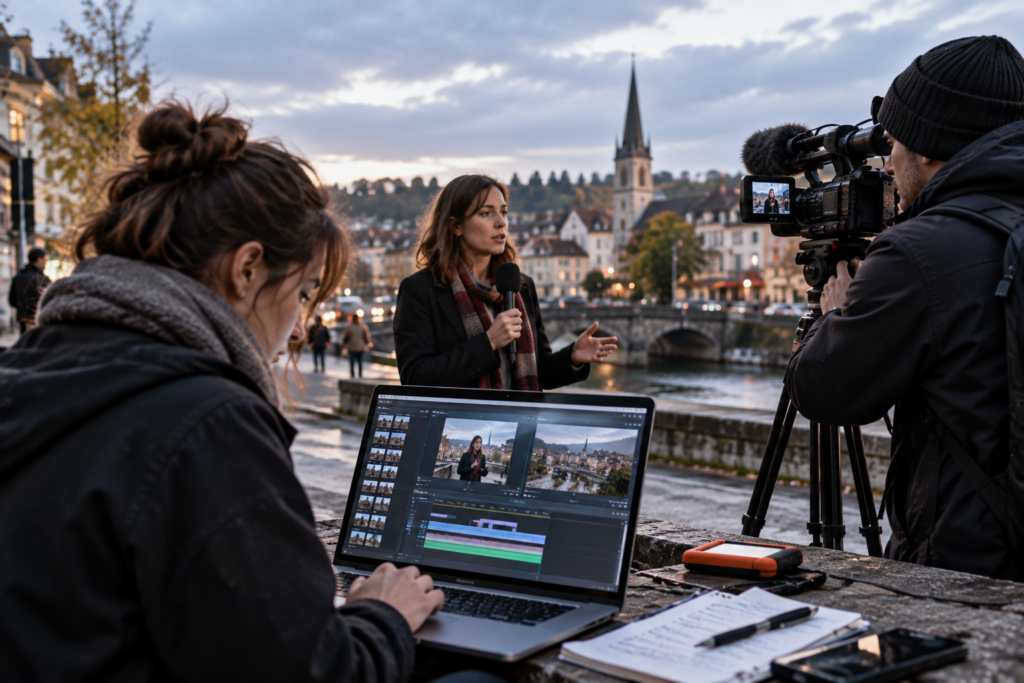
The rise of short-form video has changed expectations around how quickly and casually news can be presented. Reporters can now explain an event from the scene using equipment that fits in a pocket. Newsrooms can publish interviews, live updates and visual explainers without depending on traditional broadcast infrastructure.
This does not mean every regional story needs to become a video.
It means regional publishers need to understand when video adds something that text cannot.
A complicated local development may benefit from a reporter explaining it directly. A rapidly changing event may require visual updates. A community story may work better as a short documentary than a conventional article.
The strongest digital newsrooms are learning to treat format as part of editorial judgment.
The Community Is Becoming Part of the Product
Another major change is the relationship between publishers and audiences.
Traditional newspapers largely operated in one direction: journalists produced information and readers consumed it.
Digital regional journalism can be much more interactive.
Readers can send photographs, identify developments, contribute local knowledge, respond to reporting and participate in discussions. Newsrooms can use audience feedback to identify unanswered questions and discover stories that might otherwise remain invisible.
This does not mean turning journalism into a popularity contest.
Editors still need to decide what deserves publication.
But the community can become a source of intelligence rather than simply an audience.
Some publishers are already experimenting with models designed to involve communities more directly in local news. Reuters Institute research has highlighted emerging ideas that encourage audiences not only to read regional journalism but also to participate in the wider news ecosystem.
That could become one of the most important developments in the future of local media.
Search Is No Longer the Only Discovery Engine
Regional publishers also face a new challenge from AI-powered information discovery.
For years, search engines were one of the main routes through which readers found local journalism. People searched for a development, clicked a result and arrived at a news website.
AI chatbots are introducing another layer between the reader and the original publisher.
The Reuters Institute reported in 2026 that weekly use of AI chatbots for news had increased from 7% to 10% globally, although only 1% of respondents said AI was their main source of news. Users commonly turn to chatbots for follow-up questions, summaries and explanations.
For regional journalism, this raises a difficult question.
If an AI system explains a local issue without sending readers to the original reporting, how does the newsroom receive recognition, traffic or revenue for the work?
There is no simple answer yet.
But it reinforces the importance of producing journalism that has distinctive reporting, clear expertise and information that cannot easily be recreated from generic sources.
The Regional Newsroom of Tomorrow Will Be Smaller, Smarter and More Connected
The future of regional journalism is unlikely to look like a return to the old newspaper model.
The newsroom may have fewer traditional roles but more digital responsibilities. Reporters may produce text, audio and video. Editors may work across platforms rather than editions. AI may handle repetitive production tasks while journalists concentrate on verification, interviews, investigation and analysis.
At the same time, successful regional publishers will need stronger relationships with their audiences.
That may become the most important asset of all.
A large platform can distribute information faster. An AI system can summarise it instantly. A national publication can reach millions of readers.
But none of those advantages automatically creates local knowledge.
Regional journalism still has something difficult to automate: proximity.
The journalist who knows the community, understands its institutions and recognises why a seemingly small development matters can provide a kind of information that global platforms struggle to reproduce.
Local News Has a Digital Future — If It Can Earn Attention
The transformation of regional journalism is not really a story about newspapers disappearing and websites replacing them.
It is a story about attention.
Readers have more information than ever, but less time to process it. Platforms have made distribution faster while making competition for attention dramatically more intense. AI is now adding another layer to how people discover, interpret and question news.
Regional publishers therefore face a difficult but potentially powerful opportunity.
They need to become faster without becoming careless, more digital without losing their identity, and more efficient without reducing journalism to automated content.
The regional newsroom that succeeds will not necessarily be the one that publishes the most.
It will be the one that understands its community best, uses technology intelligently and gives people a reason to come back.
In an age when almost anyone can publish information to the world, genuinely local knowledge may become one of the most valuable forms of journalism left.