When AI Becomes a Research Partner: How Artificial Intelligence Is Changing Scientific Discovery
For centuries, scientific progress depended on a familiar rhythm. Researchers observed a problem, formed a hypothesis, designed an experiment, collected evidence and then tried to understand what the results meant. The process could be slow, especially when each new question required years of experiments and enormous amounts of data.
Artificial intelligence is beginning to change that rhythm.
AI is no longer used only to analyse results after an experiment has been completed. Researchers are increasingly applying machine learning to search scientific literature, identify patterns in complex datasets, predict promising molecules, design experiments and explore relationships that would be difficult to detect manually. The result is not a replacement for scientific reasoning, but a new layer of computational assistance that can influence almost every stage of research.
Science Is Moving Into a More Computational Era
Modern research already generates enormous quantities of information. Genomic databases contain billions of biological measurements, astronomical surveys produce vast collections of observations, and materials researchers can evaluate thousands of possible molecular combinations.
The problem is no longer simply collecting information. It is finding useful patterns inside it.
This is where AI has become particularly valuable. Machine-learning systems can examine large datasets much faster than a human research team and identify relationships that might otherwise remain hidden. Researchers can then investigate those relationships experimentally, turning computational predictions into testable scientific questions.
That changes the role of computation. Instead of functioning mainly as a tool for processing information, it can increasingly help determine which questions deserve closer attention.
From Searching the Literature to Finding Connections
One of the less visible changes is happening before experiments even begin.
Scientific research depends heavily on existing knowledge. Researchers need to understand what has already been discovered, which methods have worked, where contradictions remain and which questions have not yet been answered. As the volume of scientific publications grows, keeping track of everything becomes increasingly difficult.
AI systems can help researchers navigate this expanding body of knowledge. They can compare large collections of papers, identify connections between research areas and surface information that might otherwise be overlooked.
The importance of this development goes beyond convenience. Scientific breakthroughs often occur when ideas from different fields meet. A biological problem may require an approach from computer science, while an energy challenge may benefit from advances in materials research. AI can make these connections easier to identify.
Drug Discovery Is Becoming More Data-Driven
Medicine provides one of the clearest examples of how AI can influence scientific research.
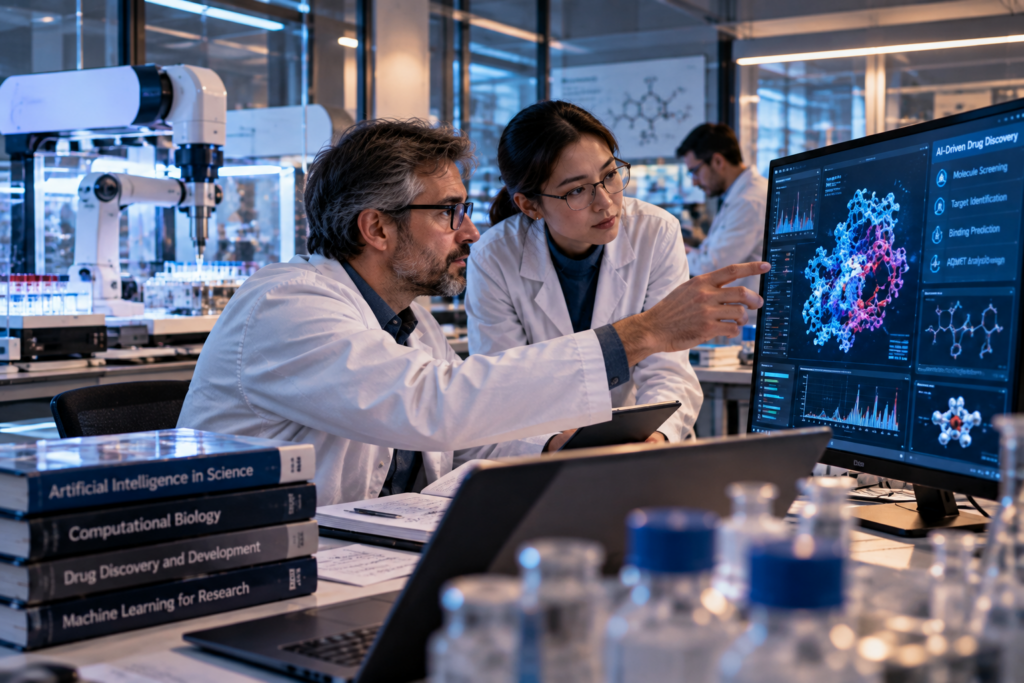
Developing a new drug traditionally requires extensive laboratory work, repeated testing and a significant amount of time. Researchers need to identify promising molecules, understand how they interact with biological targets and determine which candidates are worth taking into further development.
AI can help narrow that search.
Researchers are using computational models to predict molecular behaviour, examine biological patterns and identify promising candidates before committing to expensive laboratory experiments. The World Economic Forum’s 2026 emerging-technology report describes this broader shift as a movement in which AI helps researchers assess drug candidates and biological processes before they are physically tested.
Quantum computing may eventually add another layer to this process. Recent research has explored hybrid quantum-classical approaches for drug discovery and biological modelling, although the technology remains at an early stage and should not be confused with a mature replacement for conventional high-performance computing.
The Laboratory Is Becoming More Automated
AI is also changing what happens inside the laboratory itself.
Modern research increasingly combines software, robotics and automated instruments. A researcher can define an experimental objective while automated systems handle repetitive measurements, run controlled experiments and return new data for analysis.
This creates the possibility of a much faster feedback loop. Instead of conducting one experiment, analysing it manually and then planning the next one, researchers can increasingly connect several stages into a continuous workflow.
The technology is especially useful for experiments involving large numbers of combinations. Materials science, chemistry and biology all contain problems where researchers may need to test many possibilities before identifying a useful result.
Automation does not eliminate the need for scientists. It changes where their time is spent. Instead of performing every repetitive step themselves, researchers can concentrate more heavily on interpreting evidence, choosing research directions and deciding which questions matter.
AI Does Not Remove the Hard Part of Science
There is an important distinction between finding a pattern and understanding what that pattern means.
AI can identify a correlation in a dataset without necessarily explaining the underlying mechanism. A prediction can also be statistically convincing and still fail when tested in the physical world.
That is why experimental validation remains essential. Scientific knowledge ultimately depends on evidence that can be tested, reproduced and challenged.
This limitation is particularly important as AI-generated scientific results become more common. The faster computational systems produce hypotheses, the greater the need for researchers to determine which ones are genuinely meaningful.
In this sense, AI may increase the amount of scientific work rather than simply reducing it. More hypotheses can be generated, but more hypotheses also need to be tested.
The New Value of Human Scientific Judgment
As AI becomes better at analysing information, human expertise does not become irrelevant. In some respects, it becomes more important.
Researchers still have to decide which problems are worth solving, how an experiment should be designed and whether a computational result makes scientific sense. They also have to recognise when a model has produced an attractive but misleading answer.
The Stanford Emerging Technology Review makes a similar broader point: technological breakthroughs are necessary for innovation, but economic, political and social conditions strongly influence whether those breakthroughs become useful in practice.
Science therefore remains a human institution even when more of its processes become computational.
A Wider Scientific Transformation
The significance of AI becomes clearer when it is considered alongside other rapidly developing fields.
Biotechnology, advanced materials, robotics, energy technologies, semiconductors, neuroscience and quantum science are increasingly connected rather than developing in isolation. Stanford’s 2026 review treats these areas as part of a wider frontier in which progress in one field can accelerate research in another.
This convergence could become one of the defining characteristics of the next phase of scientific innovation.
AI can help analyse biological systems. Better biological understanding can lead to new materials or medical technologies. Advances in computing can make complex simulations more practical. Robotics can then translate digital discoveries into automated physical experiments.
The boundaries between disciplines are becoming less rigid.
The Next Breakthrough May Begin With a Model
The most interesting consequence of this transformation is not that AI will somehow become a scientist. It is that the process of discovery itself may become more collaborative between humans and machines.
A future research team could begin with a scientific question, use AI to map existing knowledge, generate several possible explanations, run simulations, select the most promising experiments and then use automated laboratory systems to test them.
The scientist would remain responsible for interpreting the evidence and deciding where the investigation should go next.
That model could make research faster, but speed is only part of the story. It could also make previously impractical questions worth investigating because computational tools reduce the cost of exploring them.
Innovation Still Depends on More Than Technology
There is a tendency to describe every major advance in AI as an inevitable step toward a technological future. Scientific progress is rarely that simple.
Research requires funding, skilled people, reliable infrastructure, open collaboration and institutions capable of evaluating new evidence. It also requires rules for handling sensitive data, intellectual property, safety and the responsible use of powerful technologies.
The United Nations’ 2026 scientific horizon report identifies this governance challenge as one of the central issues surrounding the rapid development of AI, biotechnology, energy and other emerging technologies. Scientific capabilities are advancing quickly, while institutions and regulations can struggle to keep pace.
The future of innovation will therefore depend not only on what researchers can build, but on how responsibly those capabilities are integrated into society.
A New Way to Discover
AI is changing science because it is changing the scale and speed at which researchers can explore possibilities. It can search more information, compare more variables and generate more potential directions than traditional workflows could comfortably handle.
But the fundamental purpose of science has not changed. Researchers still need to ask meaningful questions, test ideas against reality and remain willing to reject conclusions that do not survive scrutiny.
The emerging scientific landscape is therefore less about machines replacing researchers and more about expanding what research teams can attempt. If that relationship develops responsibly, some of the most important discoveries of the coming decade may begin not with a new laboratory instrument, but with a computational model pointing scientists toward a question they had not previously been able to ask.