From Morning Papers to Instant Updates: How People Are Changing the Way They Follow Regional News
There was a time when following regional news meant waiting. People picked up a newspaper in the morning, listened to a local radio bulletin on the way to work, or watched the evening news to find out what had happened nearby. The routine was predictable, and the news usually arrived at a fixed moment.
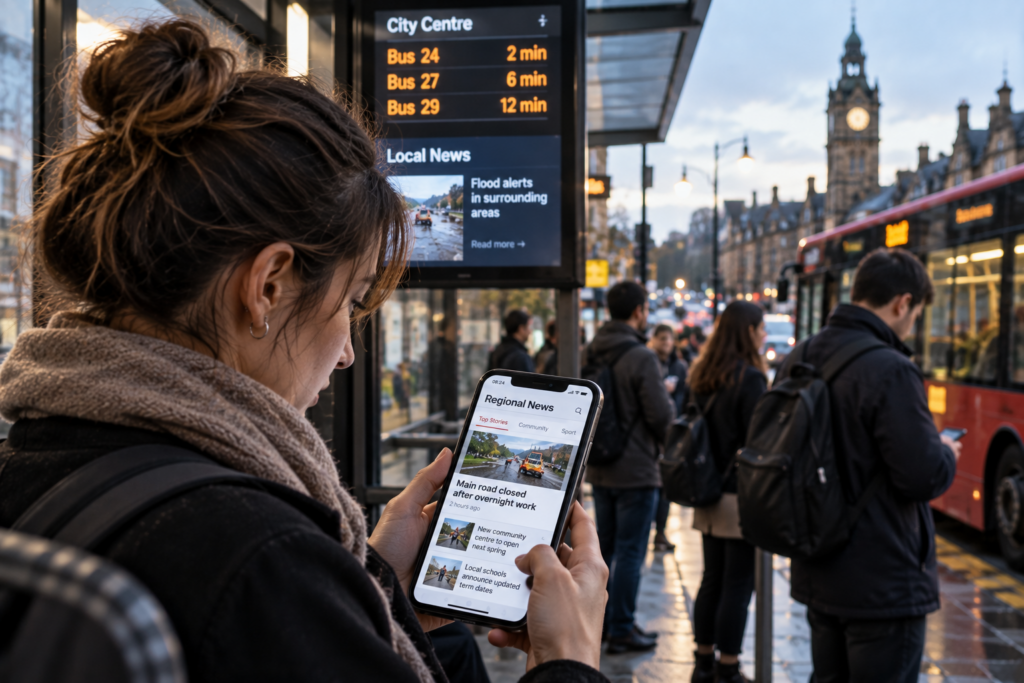
That rhythm has largely disappeared. Regional news is now woven into the rest of the digital day, appearing between messages, searches, videos and social updates. People may still visit a news website directly, but increasingly they encounter a local story somewhere else first and decide whether to follow it from there.
This change is more significant than a simple move from print to digital. It has altered the relationship between audiences and regional journalism itself. News is no longer something people necessarily sit down to consume at a particular time. It has become something they encounter throughout the day, often through several different channels.
The End of the Fixed News Hour
The modern regional news audience is less dependent on a single daily news routine. A person might see a developing story during breakfast, return to it through a notification later in the morning, watch a video update during a commute and read a longer explanation in the evening.
That fragmented pattern reflects a broader transformation in news consumption. The Reuters Institute’s 2026 Digital News Report found that social media and video networks had become the most widely used route to online news globally, reaching 54% of respondents across the 48 markets studied. News organisations’ own websites and apps followed at 51%.
Regional journalism operates within this same environment. The audience may still want reliable local reporting, but the route to that reporting is becoming increasingly indirect.
The Phone Has Become the Local Newsstand
The smartphone has made regional news available almost everywhere, but its greater importance lies in how it has changed the timing of consumption.
A local story no longer needs to wait for a newspaper edition or scheduled broadcast. It can reach readers while they are commuting, checking messages, taking a break from work or searching for information connected to their immediate surroundings.
This does not necessarily mean people spend more time deliberately reading local journalism. In fact, attention to local news can be surprisingly limited. Pew Research Center found that only 21% of U.S. adults said they followed local news very closely in 2025, compared with 37% in 2016.
The important change, therefore, is not simply how much regional news people consume. It is how easily it can enter their everyday information flow.
Local News Is Becoming More Distributed
Regional journalism is also becoming less dependent on its own website as the primary gateway to an audience.
A local newspaper may publish an article on its website, but the same reporting can appear through a social post, video clip, newsletter, search result or notification. A television station can distribute a report through its broadcast channel while simultaneously publishing it online. A community publication can build an audience almost entirely through digital channels.
Pew’s latest research illustrates the scale of this transition. In 2025, 42% of U.S. adults said they sometimes or often received local news from online-only sources, compared with 15% in 2018. Online forums and discussion groups were also used by 52%, up from 38% seven years earlier.
The result is a much more complicated local news ecosystem. The audience is no longer simply choosing between newspaper, radio and television. It is moving through a network of interconnected sources.
Video Is Changing the Local News Experience
The growing importance of video has added another layer to this transformation. Regional stories that once depended almost entirely on written reports can now be experienced through short clips, live broadcasts, interviews and visual explainers.
The Reuters Institute reports that 77% of people across its 48 markets consumed online news video each week in 2026. For the first time, a majority of respondents in every market covered by the report said they watched news online.
For regional journalism, video can be particularly effective when the story depends on place. A road closure, public meeting, weather event, construction project or community gathering can often be understood more quickly when audiences can see what is happening.
But video does not automatically replace written reporting. The strongest regional coverage often uses the two formats together, allowing a short visual update to attract attention while a fuller article provides context and detail.
Short-Form News Is Not the Same as Short Journalism
The popularity of short videos has created an important distinction between the length of a news format and the depth of the journalism behind it.
A thirty-second clip may be enough to tell people that something has happened. It may not be enough to explain why it matters, what caused it or what happens next.
That distinction becomes especially important in regional reporting because local stories often depend on context. A planning decision, transport change, school policy or development project can look simple when reduced to a headline but become considerably more complicated once the background is examined.
The challenge for regional publishers is therefore not simply to make journalism shorter. It is to make the entry point easier without removing the information audiences need.
The Rise of the Local News Creator
Another major change is the growing role of individuals who operate between journalism, commentary and community information.
Creators can build audiences around particular places, neighbourhoods or subjects without operating a conventional newsroom. They may explain local developments, record events, interview residents or simply bring attention to stories that might otherwise receive little visibility.
This does not make every creator a journalist, and audiences increasingly have to distinguish between reporting, commentary and personal observation. Yet creators have become part of the broader news environment, particularly on platforms where people already spend much of their time.
The Reuters Institute identifies this wider rise of creators and emerging news producers as one of the defining developments in today’s information environment.
For regional journalism, the development creates both competition and opportunity. Established news organisations can reach new audiences through the same spaces, while creators can sometimes draw attention to issues that traditional outlets have overlooked.
Newsletters Are Bringing Back a Sense of Habit
Digital news can feel fragmented, but newsletters have introduced a different kind of routine.
A well-designed regional newsletter arrives at a predictable time and gives readers a compact sense of what matters. Instead of asking people to discover every story through a feed, it creates a direct relationship between the publication and the audience.
That model is particularly useful for readers who want to remain informed without constantly checking multiple platforms. The newsletter becomes a filter, reducing the amount of searching required while preserving a sense of regularity that resembles the old morning newspaper.
The format also gives publishers something increasingly valuable: a direct connection with readers that does not depend entirely on changing platform algorithms.
Community Platforms Are Becoming Part of the News System
Regional information also increasingly travels through places that were never designed as traditional newsrooms.
Community forums, neighbourhood groups, local organisations and public institutions can all become sources of information. Pew found that 40% of U.S. adults said they sometimes or often received local news from local government agencies or officials in 2025, compared with 30% in 2018.
This does not mean these sources replace independent journalism. Their role is different. They may provide announcements, first-hand information or access to documents, while professional journalists add verification, context and accountability.
For audiences, however, the distinction can become less visible. The modern local information environment brings official communication, journalism, community discussion and individual reporting into the same digital space.
Search Is Becoming More Conversational
Search is changing as well. People increasingly ask questions in natural language rather than entering short keywords and opening several separate pages.
The rise of AI chatbots is part of this development. According to the Reuters Institute’s 2026 report, 10% of respondents said they used AI chatbots for news, rising to 16% among people under 35.
For regional journalism, conversational search could eventually change how audiences discover local reporting. Instead of searching for several articles about a local issue, a reader may ask a system to explain what has happened and request additional context.
That creates a new challenge for publishers. Being visible in search will remain important, but being understandable, authoritative and clearly sourced may become just as important.
The Challenge of Keeping Context
As the routes into regional news multiply, context becomes harder to maintain.
A story encountered through a short video may provide only one piece of the picture. A social post can generate discussion without establishing whether the underlying claim is accurate. A search result can surface information without explaining its significance.
This is where professional regional journalism retains an important advantage. Good reporting does not simply tell an audience what happened. It establishes what is known, what remains uncertain, who is affected and what the next development might be.
The digital environment makes the first part of that process faster. It does not make the second part less necessary.
Personalisation Can Help, but It Can Also Narrow the View
Digital platforms have made it easier for people to find information relevant to their interests. Someone can follow a particular neighbourhood, subject, institution or local issue without reading everything else published by a regional outlet.
The benefit is obvious: less irrelevant information and faster access to subjects that matter personally.
The downside is that personalisation can gradually narrow the picture. A person may become highly informed about one issue while missing other developments that could affect the wider community.
Regional journalism has traditionally performed a broader function by presenting a shared picture of what is happening in a particular area. The challenge now is to preserve that function while adapting to audiences who increasingly expect information to be tailored to them.
The New Regional Audience Is More Active
Today’s audience is not simply receiving regional news. It is participating in its distribution.
Readers share articles, comment on developments, send information to journalists, post photographs and discuss stories within community groups. Sometimes the audience becomes the first source to identify an event, while the newsroom takes responsibility for checking the information and developing it into a reliable report.
This creates a more interactive relationship between journalism and the public. It can also make regional reporting more responsive, provided that speed never replaces verification.
The most successful local news organisations are likely to be those that understand this participation without confusing audience activity with journalistic responsibility.
Regional News Is Becoming an On-Demand Service
The fundamental shift is therefore not from newspapers to smartphones or from television to social media. It is from scheduled consumption to continuous availability.
People expect regional news to be accessible when something happens, wherever they happen to be. They may encounter it through a notification, a video, a search, a newsletter or a community conversation before ever visiting the publisher’s homepage.
That expectation changes what audiences consider a good news service. Speed matters, but so do clarity, accessibility, credibility and the ability to move easily from a quick update to deeper reporting.
The best regional journalism can accommodate all of these behaviours without losing its editorial identity.
What Audiences Will Expect Next
The next stage of regional news consumption will probably be defined by flexibility rather than by one dominant format.
Readers will continue moving between text, video, audio, social feeds, newsletters, search and emerging AI interfaces. Some will want a quick update; others will want a detailed explanation. The same person may want both, depending on the moment.
That makes adaptability increasingly important for regional publishers. A strong local story should be able to travel across formats without becoming a different story every time it appears somewhere else.
The technology will continue to change, but the underlying audience need is remarkably stable. People want to understand what is happening around them and how it affects the places where they live, work and spend their time.
The New Regional News Habit
Regional news has not disappeared because people have stopped caring about their communities. The more significant change is that the old routine for finding that news has broken apart.
The morning paper, scheduled broadcast and direct visit to a news website now exist alongside feeds, notifications, video platforms, newsletters, community groups and conversational search. Each channel offers a different way into the same information environment.
For regional journalism, that creates a demanding but potentially valuable future. The audience may no longer arrive at the same time, through the same device or in the same format, but the need for reliable local information remains.
The regional news habit is becoming more flexible, more fragmented and more digital. The organisations that understand that change without sacrificing depth and trust will be best placed to remain part of people’s everyday lives.