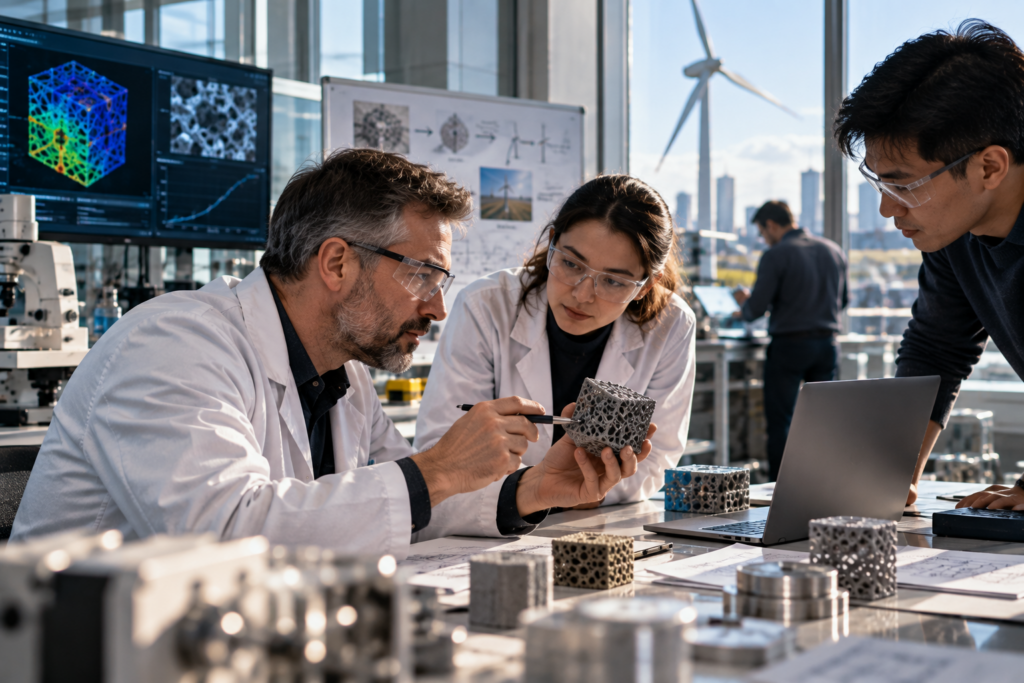
From Laboratory Breakthroughs to Everyday Technology: How Science Becomes Innovation
A scientific breakthrough does not become useful the moment it is discovered. Between a promising result in a laboratory and a technology people can actually use, there is usually a long and complicated journey.
A new material may need years of testing before it can be manufactured at scale. A medical discovery must pass through extensive validation before reaching patients. An energy technology can work impressively in a controlled experiment and still face difficult engineering problems when it is deployed in the real world.
This gap between discovery and practical use is where much of modern innovation takes place. Science creates new possibilities. Engineering turns those possibilities into working systems. Industry then has to make them reliable, affordable and scalable.
The Long Road From Discovery to Application
Scientific research often begins with a question that has no immediate commercial purpose. Researchers may be trying to understand a physical process, investigate a biological mechanism or develop a better way to measure something.
Years later, that knowledge can become the foundation for an entirely different technology.
The relationship is particularly visible in computing. Fundamental research in physics and materials science eventually contributed to technologies that transformed electronics, telecommunications and digital services. Similar patterns can be seen in biotechnology, advanced materials and energy research.
Innovation therefore rarely follows a straight line. An idea discovered for one purpose can become valuable somewhere completely different.
Materials Are Quietly Changing Technology
Some of the most important innovations do not look particularly dramatic from the outside. They involve materials that make existing technologies smaller, lighter, stronger or more efficient.
Researchers are developing advanced materials with unusual electrical, thermal, mechanical and chemical properties. These materials can influence everything from batteries and electronics to medical devices and industrial equipment.
The World Economic Forum’s 2026 overview of emerging technologies highlights advanced materials among the fields capable of influencing multiple industries because improvements at the material level can create entirely new engineering possibilities.
A better material can therefore have an effect far beyond the laboratory where it was first developed. It can change how a product is manufactured, how much energy it consumes and how long it can operate.
Energy Innovation Is a Systems Problem
The same principle applies to energy technology.
Developing a more efficient battery, solar technology or energy-storage system is only one part of the challenge. The technology must also operate safely, survive repeated use, integrate with existing infrastructure and eventually become practical to manufacture at large scale.
This is why energy innovation often progresses more slowly than laboratory demonstrations suggest. A prototype can prove that something is possible, while commercial deployment has to prove that it is dependable.
Researchers are consequently working not only on individual technologies but on the wider systems surrounding them. Storage, transmission, materials, software and energy management increasingly need to work together.
The most important breakthroughs may therefore come from combinations of technologies rather than from a single invention.
Biotechnology Is Moving Beyond the Laboratory
Biotechnology provides another example of science becoming increasingly connected with engineering.
Advances in genomics, molecular biology and computational modelling are giving researchers new ways to understand biological systems. At the same time, improvements in laboratory automation and data analysis are making it possible to conduct increasingly complex experiments.
The result is a research environment in which biology can be treated as something that can be measured, modelled and engineered with much greater precision.
That does not make living systems simple. Biology remains extraordinarily complex, and many promising discoveries fail when they encounter real-world conditions. But the ability to combine biological knowledge with advanced computation and engineering is expanding the range of problems scientists can realistically investigate.
Why Prototypes So Often Stay Prototypes
One of the biggest misunderstandings about innovation is the assumption that a successful prototype is almost the same thing as a finished product.
It is not.
A laboratory prototype may be produced in tiny quantities using specialised equipment and highly controlled conditions. Commercial technology has to operate consistently, often millions of times, while meeting safety requirements and tolerances that a research experiment may never have needed to address.
Manufacturing can become the hardest part.
A promising technology may require new factories, specialised materials, redesigned supply chains or entirely different production methods. These challenges can take years to solve, even when the underlying science is already well established.
This is why engineering deserves as much attention as discovery when discussing technological progress.
Robotics Is Connecting Digital and Physical Innovation
Robotics is helping shorten the distance between scientific ideas and physical experimentation.
Modern laboratory robots can perform repetitive procedures with a level of consistency that is difficult to maintain manually. When combined with software and machine learning, automated systems can also help researchers run experiments and analyse the resulting data more efficiently.
This creates a new relationship between digital and physical research.
A computer can suggest a promising material or biological compound. An automated laboratory can test it. The results can then return to the computational system for further analysis.
The cycle can continue with less manual intervention.
Such systems are particularly valuable in research areas where thousands of possible combinations need to be explored. Instead of asking scientists to perform every individual test, automation allows them to concentrate on interpreting results and deciding where the research should go next.
Quantum Technology Shows Why Patience Matters
Quantum technologies illustrate another important feature of scientific innovation: the distance between scientific potential and widespread practical use.
Quantum computing has attracted enormous attention because of its potential to address certain problems that are difficult for conventional computers. Yet building useful quantum systems involves substantial challenges involving hardware stability, error correction, scaling and software development.
The same pattern appears across emerging technologies. Scientific demonstrations can establish that an effect is possible long before engineers can turn it into a dependable commercial system.
That does not make early research unsuccessful. Fundamental work often provides the foundation on which later generations of technology are built.
Innovation should therefore be measured not only by what is commercially available today, but also by what researchers are making technically possible for tomorrow.
Infrastructure Can Matter as Much as the Invention
Even an excellent technology can struggle without the infrastructure required to support it.
Electric vehicles need charging networks. Advanced computing requires specialised semiconductor manufacturing and data infrastructure. New medical technologies depend on laboratories, regulatory systems and clinical facilities.
This is why innovation increasingly has to be viewed as an ecosystem.
A single invention rarely transforms an industry on its own. It usually needs complementary technologies, skilled workers, investment, regulation and customers willing to adopt it.
The more sophisticated the technology becomes, the more interconnected these requirements tend to be.
The Economics of Scaling
The transition from prototype to mass adoption also depends on economics.
Researchers may succeed in developing a technology that performs better than existing alternatives, but that advantage is not enough by itself. Manufacturers need to know whether they can produce it consistently. Businesses need to understand whether customers will adopt it. Investors need confidence that the technology can survive the long development cycle.
This is particularly important for technologies that require major infrastructure changes.
A breakthrough may therefore remain commercially limited until another innovation reduces its production cost, improves its reliability or creates a market for it.
Sometimes the missing piece is not another scientific discovery at all. It is a better manufacturing process.
Innovation Happens Through Convergence
One of the strongest characteristics of today’s scientific landscape is the growing convergence between disciplines.
Computer science is increasingly connected with biology. Materials science intersects with energy research. Robotics combines mechanical engineering, software and artificial intelligence. Neuroscience increasingly draws on advanced imaging, computation and data analysis.
The Stanford Emerging Technology Review’s 2026 edition describes this broader environment as one in which emerging technologies can reinforce one another and create new possibilities across scientific and industrial fields.
This convergence can make innovation harder to predict. A breakthrough in one field may suddenly become valuable because another field has developed the tools needed to use it.
Scientific progress is consequently becoming less about isolated disciplines and more about connections between them.
What Innovation Really Looks Like
The most visible technologies are usually the finished products: a new medical device, a faster computer, a more efficient battery or an advanced robotic system.
But innovation itself happens much earlier.
It begins with basic research, continues through experiments and prototypes, passes through engineering and manufacturing, and eventually reaches the public through products and services. At every stage, ideas can fail, change direction or combine with discoveries from somewhere else.
That long process is precisely why scientific innovation remains difficult to predict.
The next important technology may already exist as a laboratory experiment. It may simply need better materials, cheaper manufacturing, more reliable software or the right infrastructure before its potential becomes visible.
The distance between science and everyday technology is therefore not a weakness in the innovation system. It is where much of the real work happens. Discovery creates the possibility; engineering makes it practical; and scale determines whether that possibility can become part of ordinary life.