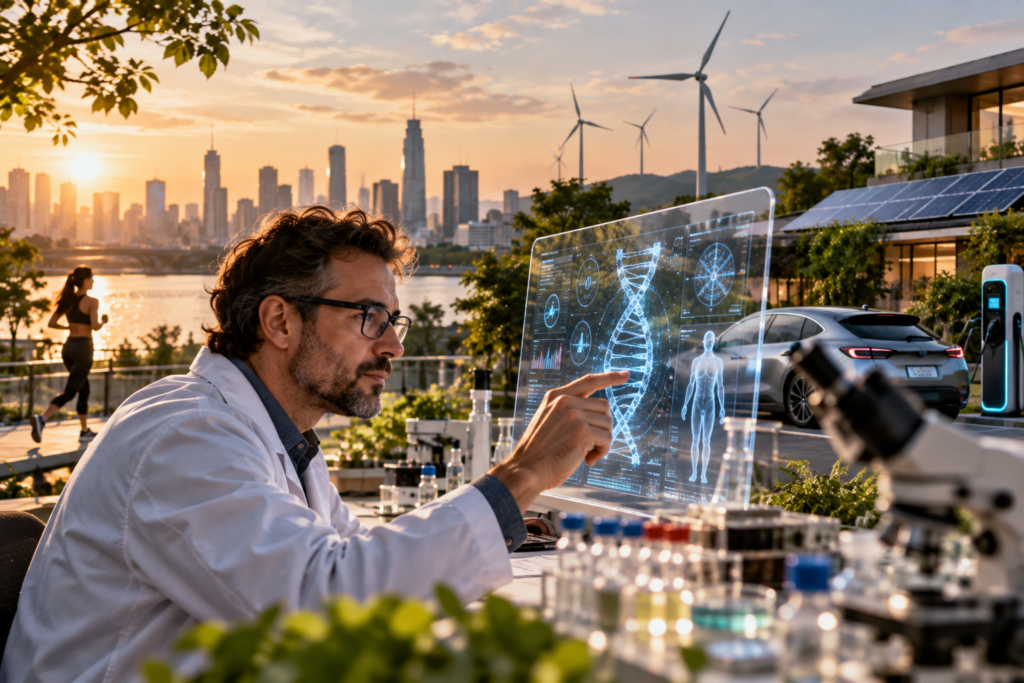
The Science We Already Use: How Emerging Technologies Are Becoming Part of Everyday Life
Some of the most important scientific advances do not arrive with a dramatic announcement. They appear quietly, first as a new capability in a device, then as a better medical test, a more efficient energy system or a new service that gradually becomes ordinary.
This is how innovation often enters everyday life. A technology that once existed only in research laboratories can eventually become so familiar that people stop thinking about the science behind it.
That transition is accelerating across several fields. Advances in biotechnology, materials science, robotics, energy systems, semiconductors and space technology are moving closer to practical applications, while researchers increasingly combine discoveries from different disciplines. The World Economic Forum’s 2026 emerging technologies report describes this moment as a point where several scientific advances are approaching wider real-world deployment.
When a Breakthrough Becomes Ordinary
The public usually notices innovation when it produces a recognisable product. The scientific work behind it may have started years or even decades earlier.
Modern medical imaging, satellite navigation and advanced computing are good examples. Their underlying technologies required fundamental research long before they became familiar tools.
The same pattern is now appearing with newer technologies. Research that once seemed highly specialised is gradually moving into products, infrastructure and services that people can use without knowing how complicated the underlying systems are.
That is one of the most important stages of innovation. A technology has truly changed everyday life when people no longer think of it as futuristic.
Medicine Is Becoming More Personal
One of the strongest directions in current science is the movement toward more personalised medicine.
Traditional healthcare has often relied on treatments designed for broad groups of patients. Advances in genomics, biological data analysis and computational modelling are making it increasingly possible to understand individual differences in greater detail.
This does not mean that every patient will soon receive a completely unique treatment. The transition is more gradual. Researchers are developing better ways to identify biological characteristics, predict how diseases may behave and determine which therapies are most likely to work.
The World Economic Forum’s 2026 technology outlook identifies increasingly personalised approaches as one of the broader patterns emerging across new scientific technologies.
The significance is not simply that medicine is becoming more technologically advanced. It is that scientific information is becoming more closely connected to individual decisions.
Biology Is Becoming an Engineering Discipline
Biotechnology is also changing the way researchers think about living systems.
Synthetic biology allows scientists to modify biological processes and design organisms or biological components for specific purposes. Researchers are exploring applications ranging from medicine and diagnostics to food production and sustainable materials.
One particularly interesting direction is cell-free biomanufacturing, in which biological systems can produce useful proteins or chemicals without relying on conventional living cells. Research highlighted by the CAS Science Team suggests that these approaches could eventually support more portable and flexible forms of biological production.
The larger development is easier to understand in practical terms. Biology is increasingly becoming something scientists can measure, model and engineer with greater precision.
That could change manufacturing as well as medicine.
Materials Are Becoming Smarter
Materials rarely receive the same attention as artificial intelligence or robotics, yet they sit underneath many of the technologies people use every day.
A lighter material can improve transportation. A more efficient semiconductor can reduce energy consumption. A stronger or more heat-resistant material can make industrial equipment safer and more durable.
Materials science is also increasingly connected with other fields. Stanford’s 2026 Emerging Technology Review describes materials science as a foundational area supporting progress in robotics, energy, space technology and synthetic biology.
This makes materials innovation particularly important because its effects can spread across several industries at once.
A breakthrough does not need to become a consumer product itself. It may simply make another technology smaller, cheaper, stronger or more efficient.
Energy Innovation Is Moving Closer to the Grid
Energy is another area where scientific research is increasingly turning into practical infrastructure.
The challenge is not simply producing electricity from cleaner sources. Modern energy systems also need better storage, more resilient grids and smarter ways of matching supply with demand.
The International Energy Agency reported in 2026 that more than 320 new energy start-ups received their first funding in 2025, while innovation activity increasingly reflects concerns about energy security, competitiveness and resilience.
This suggests that energy innovation is becoming broader than the development of individual power technologies. Software, storage, grid management and new materials are becoming part of the same technological conversation.
For consumers, many of these changes may remain almost invisible. The important result is not necessarily a new gadget but a more flexible and efficient energy system behind the scenes.
Robots Are Leaving Controlled Environments
Robotics is also moving beyond the factory floor.
For years, industrial robots were designed to perform highly repetitive tasks in carefully controlled environments. New generations of robots are being developed to operate in more complicated settings where they need to perceive their surroundings and respond to changing conditions.
That transition is technically difficult. A useful robot needs much more than mechanical movement. It requires sensors, control systems, software, power and materials that can work together reliably. Stanford notes that this interdisciplinary complexity is one reason the journey from a working robotic prototype to mass production remains challenging.
As these systems improve, robots are likely to become more common in logistics, healthcare, manufacturing and other environments where machines can perform physical tasks alongside people.
The important shift is from robots that simply repeat instructions to systems capable of responding to the world around them.
Space Technology Is Becoming Everyday Infrastructure
Space may seem far removed from ordinary life, yet many familiar services already depend on technologies developed for activities beyond Earth.
Navigation, communications, weather monitoring, remote sensing and parts of financial infrastructure rely on space-based systems. As satellite networks expand and commercial participation grows, the connection between space technology and everyday services is becoming stronger.
The OECD’s 2026 review of the space economy describes a sector increasingly shaped by commercial activity, expanding infrastructure and new technologies. It also notes that space-related scientific output has more than doubled since 2009.
The next stage could involve much more than additional satellites. Autonomous systems, robotics, advanced communications and technologies for operating in orbit are becoming increasingly important.
Space innovation is therefore becoming less about distant exploration alone and more about infrastructure that supports life on Earth.
The Invisible Technology Layer
One reason emerging science can be difficult to appreciate is that much of it operates beneath the visible surface of everyday life.
People notice a faster phone or a new medical device. They rarely see the semiconductor improvements, materials research, software development or manufacturing techniques that made it possible.
The same will probably happen with many technologies currently described as emerging.
Once a new system becomes reliable and affordable, its scientific origins tend to disappear from public attention. What once looked experimental becomes infrastructure.
This is not a sign that innovation has become less important. It is often evidence that innovation has succeeded.
The Technologies Are Starting to Converge
Perhaps the most important development is that these fields are no longer progressing independently.
AI can help design new materials. New materials can improve robots and energy systems. Biotechnology increasingly relies on computation. Robotics can automate scientific experiments. Space technology depends on advances in semiconductors, communications, materials and autonomous systems.
Stanford’s 2026 review covers ten major frontier areas, including AI, biotechnology, energy, materials science, neuroscience, quantum technologies, robotics, semiconductors and space. The grouping itself reflects how closely these fields are beginning to interact.
Innovation is therefore becoming less about a single breakthrough and more about combinations of capabilities.
A technology that seems limited on its own can become transformative when another field provides the missing piece.
What Comes Next
The next generation of scientific innovation will probably feel less like a sudden technological revolution and more like a gradual change in the systems surrounding everyday life.
Medical decisions may become more precise. Energy networks may become more adaptive. Manufacturing may rely on increasingly capable robots. New materials may improve products without changing their appearance. Space infrastructure may become even more deeply integrated into communication and information services.
At the same time, not every promising technology will succeed. Scientific potential still has to overcome engineering limitations, cost, regulation, infrastructure and public acceptance. The United Nations’ 2026 scientific horizon assessment warns that technological capabilities are advancing faster in some areas than governance systems can adapt, making responsible development increasingly important.
That is why the future of science cannot be measured only by the number of breakthroughs announced each year.
The more meaningful question is what happens after the breakthrough. Can it become reliable? Can it reach people? Can it operate at scale? And can society use it responsibly?
The most successful innovations will eventually stop looking futuristic. They will simply become part of the world around us — working quietly in hospitals, homes, factories, energy networks and digital services. By the time most people notice them, the science may already have been developing for years.