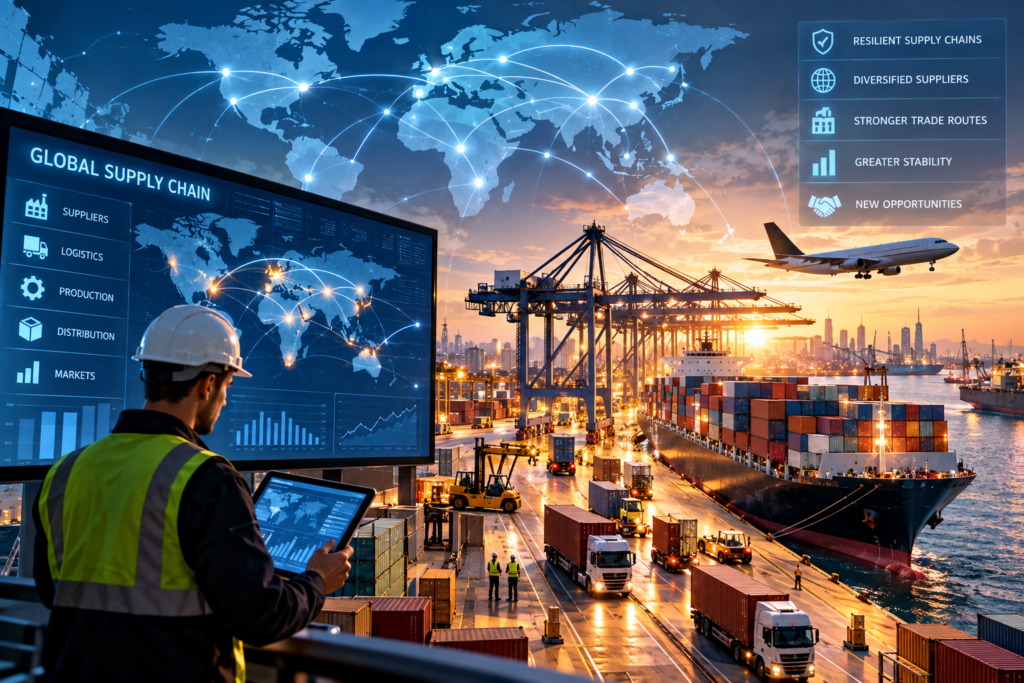
The New Shape of Global Trade: Why Supply Chains Are Being Rebuilt
For much of the modern global economy, efficiency was the central principle behind international supply chains. Companies searched for competitive production costs, reliable logistics, specialized suppliers, and access to large consumer markets. Components could cross several borders before becoming a finished product, while businesses treated distance as a manageable cost rather than a strategic risk.
That model has not disappeared, but its priorities are changing.
In 2026, global trade is increasingly being shaped by a different calculation. Companies still care about cost, but they are paying more attention to resilience, geopolitical exposure, tariffs, energy security, regulatory requirements, and the possibility that a critical supplier may suddenly become unavailable.
The result is not a simple retreat from globalization. Instead, global commerce is becoming more complicated.
Recent OECD research shows that global value chains remain highly internationalized. In real terms, the use of imported goods and services in global production was near its historical peak in 2024. At the same time, sourcing structures and trade relationships are being reconfigured rather than simply shortened or brought entirely back to domestic markets.
That distinction is important. The global economy is not necessarily moving from globalization to isolation. It is moving toward a more carefully managed form of globalization.
Efficiency Is No Longer the Only Objective
The traditional supply-chain calculation was relatively straightforward.
A company could compare suppliers according to price, quality, capacity, delivery times, and reliability. If production in another country reduced costs significantly, moving manufacturing there could make economic sense even after transportation expenses were included.
But the economic value of low production costs changes when unexpected disruption becomes more expensive.
A factory shutdown, trade restriction, sanctions regime, sudden tariff increase, shipping interruption, or shortage of a critical component can stop an entire production line. The original saving achieved through cheaper sourcing may look much less attractive once the cost of interruption is included.
This is why companies are increasingly thinking about resilience as an economic variable.
A slightly more expensive supplier may be valuable if it provides geographic diversification. A second manufacturing location may appear inefficient during normal conditions but become extremely valuable during a crisis.
The objective is therefore changing from minimizing every individual cost to optimizing the total risk-adjusted cost of operating a supply network.
Globalization Is Being Reconfigured, Not Simply Reversed
The idea of widespread reshoring has become popular in business discussions, but the actual picture is more complicated.
OECD analysis published in July 2026 found that global value chains remain deeply globalized and that recent developments are driven more by changes between sectors and sourcing structures than by a universal move toward shorter supply chains.
This means companies are not necessarily abandoning international production.
Instead, they may be changing how international production is organized.
A business that once depended heavily on one country may add suppliers elsewhere. A manufacturer may establish production capacity in another region while retaining its existing factories. A multinational may divide production among several countries so that a disruption in one location does not stop the entire operation.
This creates a more distributed model.
The supply chain remains international, but dependence on any single point becomes less desirable.
The Rise of the Connector Economy
One of the more interesting consequences of supply-chain restructuring is the growing importance of countries that sit between major production and consumer markets.
These economies can become connectors.
They may provide manufacturing capacity, logistics infrastructure, assembly services, specialized components, or access to regional trade agreements. A country does not necessarily need to replace an established industrial giant to benefit from changing supply-chain strategies.
It may instead become part of the new network surrounding that giant.
The OECD’s 2026 analysis specifically highlights the growing role of connector economies as global value chains are reconfigured.
This creates opportunities for countries that can offer the right combination of infrastructure, skilled labor, regulatory stability, market access, and predictable business conditions.
It also increases competition between emerging production hubs.
Companies are no longer evaluating locations only according to wage levels. They are considering the entire business environment.
Tariffs Have Become a Business Planning Variable
Trade policy can influence a company’s economics long before a shipment arrives at a border.
A tariff changes the cost structure of an imported product. If the product is a component rather than a finished consumer good, that higher cost can travel through several stages of production.
The effect can therefore be larger than the original tariff rate suggests.
A manufacturer may face higher input costs, while a distributor faces increased acquisition costs and a retailer faces pressure on margins. Ultimately, companies have to decide whether to absorb the additional expense, raise prices, find another supplier, redesign the product, or change where the product is manufactured.
UN Trade and Development identified rising tariffs and trade-policy uncertainty as major forces shaping global trade in 2026. It also noted that tariffs can influence sourcing decisions and investment planning even before they fully take effect.
This makes trade policy part of ordinary business strategy.
Executives increasingly need to understand not only what their products cost to manufacture, but how those costs might change if governments alter trade rules.
The Cost of Diversification
Supply-chain diversification sounds straightforward until a company has to pay for it.
Maintaining relationships with several suppliers can require additional audits, contracts, quality controls, logistics arrangements, inventory planning, and management resources.
Producing in multiple countries can also mean operating more facilities or accepting lower economies of scale.
This creates a central economic tension.
Resilience has value, but resilience is not free.
A company that creates excessive redundancy may become unnecessarily expensive. A company that optimizes exclusively for efficiency may become dangerously dependent on a small number of suppliers.
The challenge is finding an appropriate balance.
This is why supply-chain strategy increasingly resembles financial risk management. Businesses have to decide how much they are willing to spend to reduce the probability or impact of a disruption.
Inventory Is Becoming a Strategic Decision
For years, businesses often treated inventory as something to minimize.
Holding excess stock ties up capital. Warehousing costs money. Unsold goods can lose value. Efficient supply chains therefore attempted to synchronize production and demand as closely as possible.
Greater uncertainty changes that calculation.
If a company expects a critical component to become difficult to obtain, holding additional inventory may become economically rational. The inventory acts as a buffer between the company and an unpredictable external environment.
This does not mean every business should return to maintaining enormous warehouses.
Instead, companies are becoming more selective about what they stock.
Critical components with long replacement times may receive more attention than easily substituted items. Products exposed to geopolitical or transportation risks may require different inventory strategies from locally sourced goods.
The result is a more sophisticated approach to working capital.
Inventory is not simply a cost. In some circumstances, it is insurance.
Services Are Part of the Global Supply Chain Too
Supply-chain discussions often focus on physical products: machinery, electronics, vehicles, chemicals, food, and industrial components.
But modern international production also depends heavily on services.
Financial services, software, engineering, logistics, consulting, data processing, design, marketing, and professional services can all operate across borders. Multinational companies frequently rely on foreign affiliates to provide services within international production networks.
The OECD’s 2026 research emphasizes that services supplied through foreign affiliates are a larger and more complex part of global value chains than conventional cross-border trade statistics alone might suggest.
This matters because the geography of global commerce is not determined only by where factories are located.
A company may manufacture a product in one country, design it in another, manage software development somewhere else, and provide customer support through a separate regional operation.
The modern supply chain is therefore partly physical and partly digital.
Energy Has Become a Strategic Input
Another factor complicating international business is energy.
Energy prices affect transportation, manufacturing, data centers, logistics, chemicals, metals, agriculture, and almost every other sector of the economy.
The IMF’s July 2026 outlook described global growth as uneven, with war-related energy shocks weighing particularly on exposed economies. The IMF projected global growth of 3.0% for 2026 and 3.4% for 2027 while emphasizing continuing geopolitical and commodity-related risks.
For companies, energy exposure is therefore becoming part of location strategy.
A manufacturing site with low labor costs may be less attractive if its energy supply is expensive or unreliable. Conversely, a region with strong access to stable and relatively affordable energy can become more competitive even if other operating costs are somewhat higher.
This is particularly relevant for energy-intensive industries.
The location of production increasingly depends on the full cost of operating the facility, not simply the cost of employing workers.
Technology Is Reshaping the Map Too
Technology is another force changing global production.
Automation can reduce the importance of labor-cost differences between countries. Advanced manufacturing equipment can make higher-cost locations more competitive when productivity increases sufficiently.
At the same time, demand for semiconductors, computing infrastructure, advanced electronics, and AI-related equipment is creating new concentrations of investment.
The IMF has noted that AI-driven demand is benefiting economies integrated into the global technology value chain, while the broader global outlook remains exposed to uncertainty surrounding the pace of technology-driven productivity gains.
This creates an unusual situation.
Technology can make some forms of production more geographically flexible while simultaneously increasing the importance of specialized technology hubs.
The result is not a uniformly distributed global economy. It is a network of increasingly specialized regions.
Regulation Is Becoming Part of Competitiveness
Companies also have to navigate a growing range of regulatory requirements.
Environmental standards, product rules, labor requirements, data regulations, carbon-related measures, and reporting obligations can affect the economics of international trade.
A product may be inexpensive to manufacture but expensive to sell in a particular market if it requires extensive compliance work.
UN Trade and Development has identified tighter regulation and changing trade rules as important forces reshaping global commerce in 2026.
This means companies increasingly evaluate markets according to regulatory compatibility.
The cheapest production route is not always the most economically efficient route once compliance costs are included.
Smaller Businesses Face a Different Challenge
Large multinational companies have more options when supply chains need to change.
They can negotiate with multiple suppliers, move production between facilities, maintain larger inventories, and employ teams dedicated to trade compliance.
Smaller businesses have fewer resources.
A small importer may depend heavily on one manufacturer. A specialized retailer may have limited bargaining power. A small industrial company may not have enough volume to justify maintaining multiple suppliers.
For these businesses, supply-chain resilience can therefore be more difficult to achieve.
But smaller companies can sometimes compensate through flexibility.
They may change suppliers faster, adapt product ranges more quickly, or focus on markets where they have strong local knowledge.
The economic challenge is to identify which risks genuinely threaten the business and which risks can reasonably be accepted.
The New Value of Strategic Visibility
One of the most important changes in supply-chain management is the growing importance of visibility.
Companies cannot manage risks they cannot see.
Knowing the immediate supplier is no longer always enough. A manufacturer may need to understand where critical raw materials originate, which ports are used, what alternative suppliers exist, and how long replacement would take.
This creates demand for better data and more detailed mapping of business dependencies.
The objective is not necessarily to eliminate every risk. That would be impossible.
The objective is to know where the risks are concentrated and decide which ones deserve investment.
In economic terms, information can reduce uncertainty.
A company with clear visibility into its supply chain can react more quickly when conditions change than one that discovers a dependency only after a disruption has already occurred.
Global Trade Is Becoming More Political
The economic logic of international trade has traditionally emphasized comparative advantage and efficiency.
Those principles remain important, but governments are increasingly considering strategic factors alongside pure economic efficiency.
Industrial policy, national security, energy independence, critical minerals, food security, advanced technology, and domestic manufacturing capacity are now closely connected to trade policy.
Recent G20 discussions illustrate the difficulty of reaching agreement on these issues. In early October 2026, trade ministers remained divided over industrial overcapacity and some aspects of trade policy, particularly concerning China, while agreeing on other areas such as opposition to the coercive use of food trade.
For businesses, this means geopolitical developments can no longer be treated as distant political stories.
They can directly affect sourcing, investment decisions, production costs, and access to markets.
Fragmentation Has a Real Economic Price
There is a temptation to assume that a more fragmented global economy automatically creates greater security.
The reality is more complicated.
Duplicating factories, maintaining alternative suppliers, building redundant logistics networks, and accepting higher production costs can improve resilience. But if every country and company attempts to isolate itself from every external risk, global efficiency can decline substantially.
The WTO’s 2026 World Trade Report estimates that a highly geopolitically fragmented global trading system could reduce global GDP by 5.1% and global exports by 18.6% compared with a more integrated baseline. The report also finds significantly larger losses in a scenario where multilateral cooperation is replaced entirely by a network of preferential trade agreements.
The message is not that companies should ignore geopolitical risks.
It is that resilience and openness have to coexist.
The Next Generation of Supply-Chain Strategy
The future of global trade is unlikely to be defined by one simple model.
Some companies will continue to rely heavily on international production. Others will bring selected activities closer to their primary markets. Many will use a hybrid approach, retaining global suppliers while adding regional alternatives.
The key change is that supply-chain design is becoming more strategic.
Businesses are asking questions that were less prominent when efficiency dominated decision-making.
How dependent are we on one country? How quickly can we replace a supplier? What happens if tariffs rise? Which components are genuinely critical? How much inventory should we hold? Where are our energy risks? Which regulations could change the economics of a market?
These are no longer questions reserved for logistics departments.
They increasingly belong in boardrooms and investment plans.
A More Resilient but More Complicated Global Economy
The global economy is not simply moving toward deglobalization.
The evidence suggests something more nuanced. Global value chains remain extensive, but businesses are changing their sourcing structures, governments are becoming more active in trade policy, and geopolitical uncertainty is influencing investment decisions.
That transition will have winners and losers.
Countries with strong infrastructure, skilled workforces, reliable institutions, energy capacity, and access to major markets may attract new investment as companies diversify their production networks. Businesses that understand their dependencies and adapt early may be better positioned to absorb disruption.
Others may face higher costs without gaining enough resilience to compensate.
The central economic challenge of the coming years will therefore not be choosing between globalization and localization. It will be deciding how much global integration a company can maintain while making its operations resilient enough to withstand a more uncertain world.
Global trade is changing shape rather than disappearing. The businesses that understand that distinction will be better prepared for the economics of the next phase.